





Key ideas
- CLEAN presents Energy 101 Solar PV as a visual and verbal introduction to photovoltaic conversion; the resource page notes that it does not explain in depth the direction of electron flow and voltage.
- The U.S. Department of Energy references explain how semiconductors convert light into electricity and what factors limit efficiency; they provide scientific context, not independent corroboration of the video.
- Activities for elementary and secondary school and the use of virtual tours are proposed as hypothetical options: the documentation does not identify a specific tour or demonstrate the effectiveness of a universal teaching sequence.
Start with the conversion of light into electricity
Teaching solar energy can begin with a simple question: how is sunlight transformed into electricity? The CLEAN educational collection features a video titled Energy 101 Solar PV as a visual and verbal explanation of how a photovoltaic panel works. The resource page characterizes the material as an introduction to the topic and notes that it presents light in terms of photons.
To develop this introduction, it is helpful to separate a few ideas. A photovoltaic cell contains a semiconductor material that can absorb sunlight and convert it into electricity. The absorbed energy is transferred to electrons in the material; their movement can produce electric current, which is extracted through conductive contacts. Not all semiconductors convert light into electricity, and the materials used in solar cells have their own advantages and challenges.
Light can be described as photons, packets of energy with different wavelengths. Not all the light that reaches a cell is converted into electricity: some is reflected, some passes through the material, and some of the absorbed energy is transformed into heat. Some photons have the right amount of energy to separate electrons from their bonds and produce charge carriers that contribute to the current. This model does not imply that every photon produces usable electricity.
Conversion efficiency expresses the proportion of solar energy incident on a device that is converted into usable electricity. Factors that limit it include the wavelength of the light, the recombination of electrons and holes, temperature, and reflection. Thus, an introductory video can help present the mechanism, but it does not replace an explanation of the losses and conditions that affect performance.
Videos and virtual tours: formats, not guarantees of access
CLEAN describes Energy 101 Solar PV as a clear visual and verbal explanation and a non-specialist introduction. The resource page also notes a conceptual limitation: the resource does not explain in depth why electrons flow in a particular direction to establish a voltage. It can therefore be used as a starting point and accompanied by questions, not as a complete explanation of every aspect of the technology.
CLEAN’s resource page mentions a U.S. Department of Energy address for obtaining information and graphics. That historical reference does not establish that an old page is still active. The U.S. Department of Energy references included here separately explain photovoltaic cells and the factors that affect their efficiency. They provide scientific context, but do not independently corroborate CLEAN’s description of the video.
CLEAN’s documentation provides guidance on the video format and mentions materials related to energy; it does not describe a specific virtual tour, its images, or its features. Therefore, it does not allow us to recommend a particular experience or state what elements could be explored. If a virtual tour available in the educational setting is incorporated, the teacher can first check its accessibility, the availability of captions or text alternatives, its learning objective, and its suitability for the age group. This is a selection guideline, not a claim about the characteristics of a specific resource.
| Resource or format | What the documentation provides | Caution when using it |
|---|---|---|
| Energy 101 Solar PV video described by CLEAN | A visual and verbal introduction to how a photovoltaic panel works; presents light as photons. | It is an introduction and does not explain in depth the direction of electron flow or all the limits on performance. |
| CLEAN page | Educational context and comments on the audiovisual material. | The resource page mentions a historical reference; it does not confirm that another link is still available. |
| U.S. Department of Energy references | Explain semiconductors, photovoltaic conversion, and factors that limit efficiency. | They are sources of scientific context, not independent evidence about the content or availability of CLEAN’s video. |
| Virtual tour | Could be considered as a format for observing an installation if an appropriate resource is available. | The documentation does not identify a specific tour or allow its content or accessibility to be described. |
Hypothetical activities for elementary and secondary school
The following proposals are hypothetical: they are ways to organize teaching based on the documented concepts, not evaluated activities or demonstrated learning outcomes.
In elementary school, the teacher can show the video or give a brief explanation and ask students to represent the path of energy in a drawing: light reaching a cell, interacting with the semiconductor, and electricity coming out through the contacts. The activity can focus on distinguishing “light,” “material,” and “current,” without requiring explanations of details that CLEAN’s resource page does not cover.
In secondary school, the class can compare a simple cell diagram with a sequence of photons: some are reflected, others pass through the material, and others are absorbed. The guiding question would be what happens to the energy in each case. The diagram should be presented as an explanatory model, not as a measurement of a specific cell.
In a more in-depth activity, students can be asked to explain why efficiency is not the same as converting all incident light into electricity. The answer can be organized around the documented factors: reflection, transmission, conversion into heat, recombination, and temperature. Different families of semiconductors can also be compared qualitatively, without inferring that one technology is always superior for every application.
If a video or virtual tour is used, a cross-cutting task could ask students to identify what they observe directly and what they interpret based on a model. For any specific digital resource, the teacher should check that it is available and provides the access conditions and support their group needs. The documentation does not allow a universal sequence by age to be established or a claim to be made that an audiovisual format is effective for all students.
Adjusting the depth without sacrificing accuracy
Adapting materials by age does not just mean shortening an explanation. An initial approach can discuss light providing energy to a material and electricity that can be used. Semiconductors, electrons, and conductive contacts can then be introduced; at more advanced levels, photons, wavelength, recombination, voltage, and efficiency. This progression is a teaching proposal based on the concepts in the sources, not a curriculum classification validated by them.
It is also important to distinguish the general message from its limitations. CLEAN summarizes the video’s message as generating electricity by converting solar energy and notes that the material presents photovoltaic systems as a way to generate energy without pollution. This statement should be understood as the message attributed to the video; the contextual references cited here concern how cells work and their performance, not an assessment of all the environmental impacts of an installation or its life cycle.
A classroom guide can combine an audiovisual introduction, a graded explanation of the photovoltaic effect, and an activity interpreting models. The U.S. Department of Energy references can be used to explore the science of semiconductors and efficiency further; CLEAN’s resource page provides the educational context for the video. Keeping these roles separate helps distinguish what each material describes and which aspects fall outside its scope.
References
What we know and its limits
The documentation describes a CLEAN educational resource page and provides U.S. Department of Energy references for context on photovoltaic cells and efficiency. It does not specify a particular virtual tour or confirm the current availability of the video or historical links, and it does not evaluate the effectiveness of age-based activities. The references on cells and performance do not, by themselves, document life-cycle environmental impacts or every aspect of a solar installation.
Original sources3
The original sources for exploring this explanation and its limits.
-
Solar Photovoltaic Cell Basics
U.S. Department of Energy
Photovoltaic conversion and semiconductor families. -
Solar Photovoltaic Performance and Efficiency Basics
U.S. Department of Energy
Optical losses, recombination, temperature, and efficiency measurement. - Teaching renewable and solar energy: videos, virtual tours, and activities by age group CLEAN
Image credits
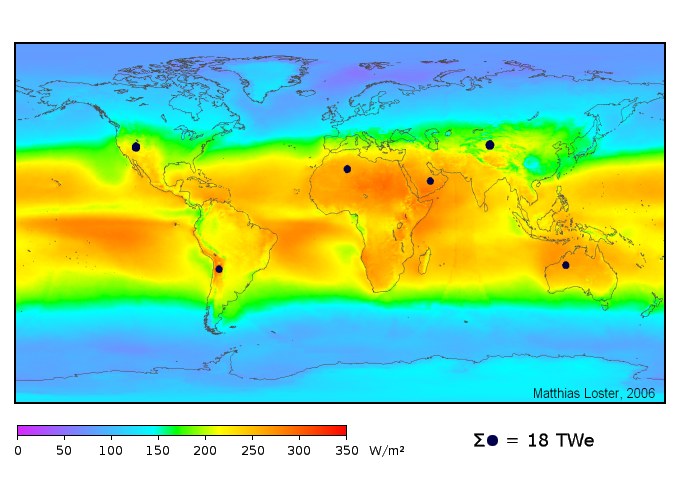
solar energy — Solar land area · Mlino76 · Wikimedia Commons · CC BY 2.5 · Original source · CC BY 2.5 · Resized and re-encoded as JPEG; full framing preserved.