





Key ideas
- Rocks are classified as sedimentary, igneous, and metamorphic according to how they form or transform.
- Mineral composition and texture offer clues about processes such as sedimentation, magma cooling, and metamorphism.
- The BGS describes downloadable educational materials, rock information sheets, and loan kits to support Earth science learning.
Rocks and Minerals: Different Concepts
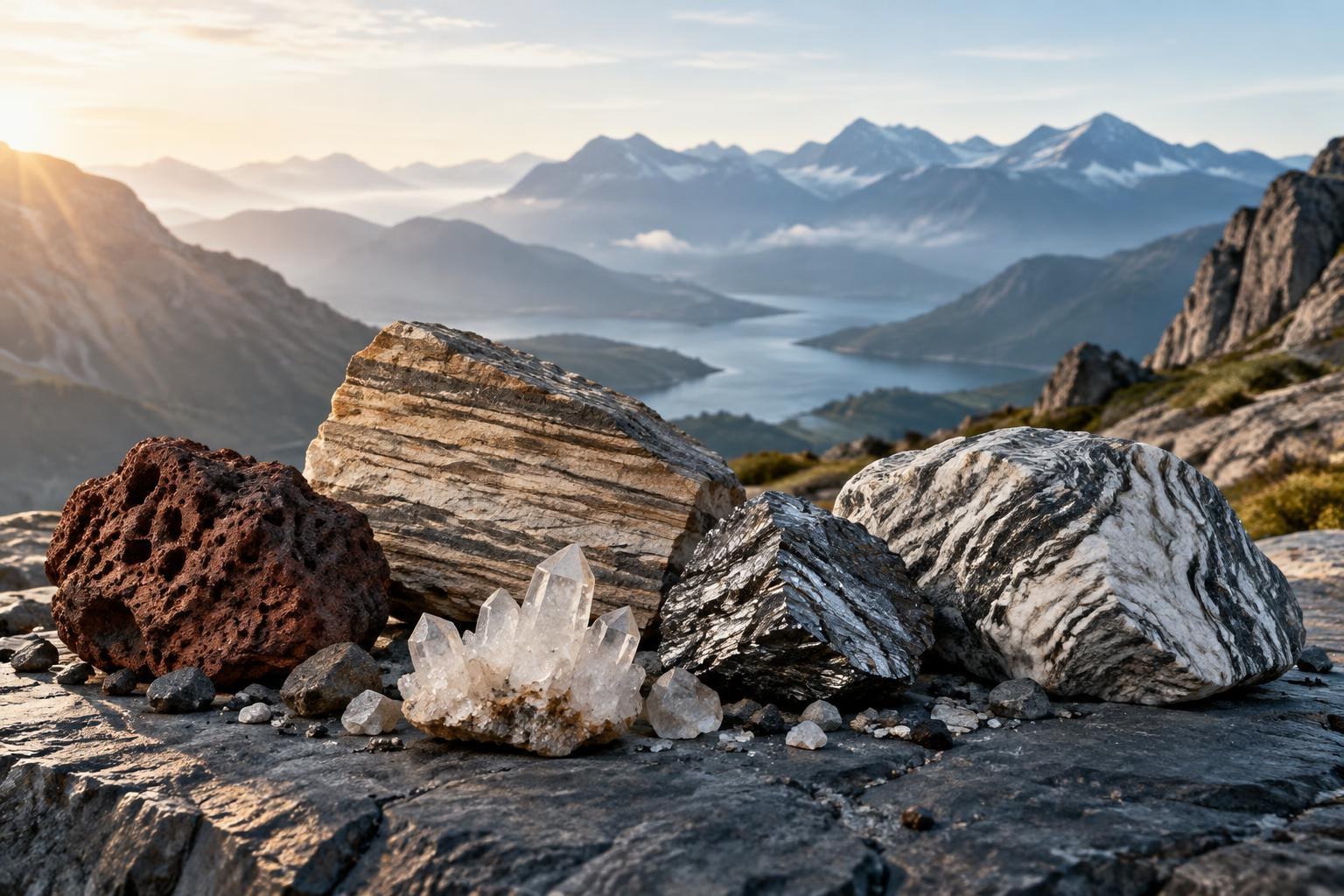
A rock is a solid assemblage of minerals; a mineral, by contrast, is a naturally occurring substance with characteristic physical and chemical properties, composition, and atomic structure. Rocks usually combine two or more minerals, although their proportions and arrangement depend on the geological processes that formed them. Granite, for example, mainly contains quartz, feldspar, and mica as interlocking crystals; in sandstone, these minerals may occur as grains compacted and cemented together.
This distinction makes it possible to read a rock as the result of a history: where its components came from, how they accumulated or cooled, and what changes they underwent afterward. The British Geological Survey (BGS) organizes rocks into three broad groups according to how they form: sedimentary, igneous, and metamorphic. The classification describes their origin, not a scale of age or importance.
Three Ways Rocks Form
Sedimentary rocks form from eroded and altered fragments of other rocks, which are transported—for example, by rivers or wind—and deposited. Sediments usually accumulate in seas and lakes, although they can also accumulate in deserts. As they build up, they form layers called strata; burial beneath younger sediments compresses them until they become rock.
Some sedimentary rocks have a different starting material. Deposits on the seabed composed almost entirely of shell fragments can form limestone: shells are made largely of calcium carbonate and, when compressed, give rise to this rock. The accumulation of large quantities of dead plant matter can turn into coal over millions of years.
Igneous rocks result from the cooling of magma, very hot molten material that originates inside Earth. If magma reaches the surface through an opening or fissure, it is called lava and cools rapidly when exposed to air and water. The resulting crystals are usually very small: the rock is described as fine-grained. If magma cools slowly below the surface, by contrast, crystals can grow and become visible to the naked eye. Granite is an example of an intrusive igneous rock, coarse-grained and generally light-colored. Although it formed at depth, it can become exposed after processes of uplift, erosion, and weathering that act over millions of years.
Metamorphic rocks are pre-existing rocks—sedimentary, igneous, or metamorphic—that change physically or chemically, or both. Metamorphism can occur when rocks are buried and subjected to high temperatures and pressures over millions of years. It can also occur through contact with hot igneous material: the rock is “baked” without melting; this process is called contact metamorphism. Thus, limestone can transform into marble and a mudstone rock into slate.
What Clues Minerals and Textures Provide
Composition and texture help link a sample to the process that formed it. In granite, interlocking crystals of quartz, feldspar, and mica are consistent with slow cooling at depth; in sandstone, compacted and cemented mineral grains reflect the accumulation and consolidation of sediments. The visible crystal size in some igneous rocks also offers a clue: in the BGS diagram, rapid cooling of lava is associated with small crystals, while slow cooling of underground magma is associated with larger crystals.
These observations do not make any single characteristic a complete explanation for every sample. The classification summarized here links specific examples to general processes; it does not provide a catalog of mineral species or a detailed identification procedure. For educational purposes, the BGS says it offers free downloadable materials, information sheets about rocks, and rock sample loan kits. It also presents Earth science resources for school-age students and other audiences.
From Visible Rocks to Earth's Interior
Surface rocks are part of a planet whose internal structure is not known simply by directly observing its deep layers. As methodological context, the U.S. Geological Survey (USGS) explains that knowledge of Earth's interior is based, among other data, on the paths and characteristics of seismic waves, laboratory experiments on rocks and minerals under high pressure and temperature, and geological observations of surface rocks. Wave speeds change as they pass through different materials, so seismic records make it possible to investigate structures that have not been directly observed.
This context connects the study of rocks with geophysics, but it is not independent verification of the BGS's classification and educational examples: it provides general methods for investigating Earth's interior. Similarly, the USGS page on earthquakes explains that seismic waves are recorded by seismographs and that the difference in arrival times between P and S waves can help estimate the distance to an earthquake; that information concerns seismic observation, not confirmation of the examples of rock formation.
| Rock group | Process described | BGS example | Feature mentioned |
|---|---|---|---|
| Sedimentary | Deposition and compaction of sediments | Limestone | Can form from compressed shell fragments |
| Igneous | Cooling of magma or lava | Granite | Visible crystals and coarse-grained texture in the intrusive example |
| Metamorphic | Transformation of a pre-existing rock by heat and pressure, or through contact with hot igneous material | Marble | Can originate when limestone undergoes metamorphism |
The comparison summarizes the processes and examples presented by the BGS; it does not replace analysis of a specific sample. Overall, the classification shows how a rock's origin, minerals, and texture are related. It also offers a starting point for exploring processes that continue to modify Earth's surface and for using geology teaching resources in the classroom.
What we know and its limits
The explanation summarizes the classification and educational examples from the British Geological Survey; it does not provide an exhaustive method for identifying samples or an inventory of minerals. The USGS references offer context on seismic methods and Earth's interior, but they do not independently corroborate the BGS examples.
Original sources3
The original sources for exploring this explanation and its limits.
-
The Interior of the Earth
U.S. Geological Survey
Seismic and experimental evidence about Earth's layers. -
The science of earthquakes
USGS
Institutional reference for context. It does not constitute independent confirmation of the main source's findings. -
Rocks and minerals
British Geological Survey
Institutional reference for context. It does not constitute independent confirmation of the main source's findings.
Image credits
Editorial illustration by SciClue