





Key ideas
- NASA expects the eight IROSA arrays to jointly increase power for research and operations by more than 160 kW.
- The arrays are approximately half the size of the station’s previous ones and can produce about 28 kilowatts of additional power.
- Six IROSA arrays were installed between 2021 and 2023; NASA says another set was requested in 2023 and launched in the cargo compartment of a Dragon spacecraft.
What upgrade NASA describes
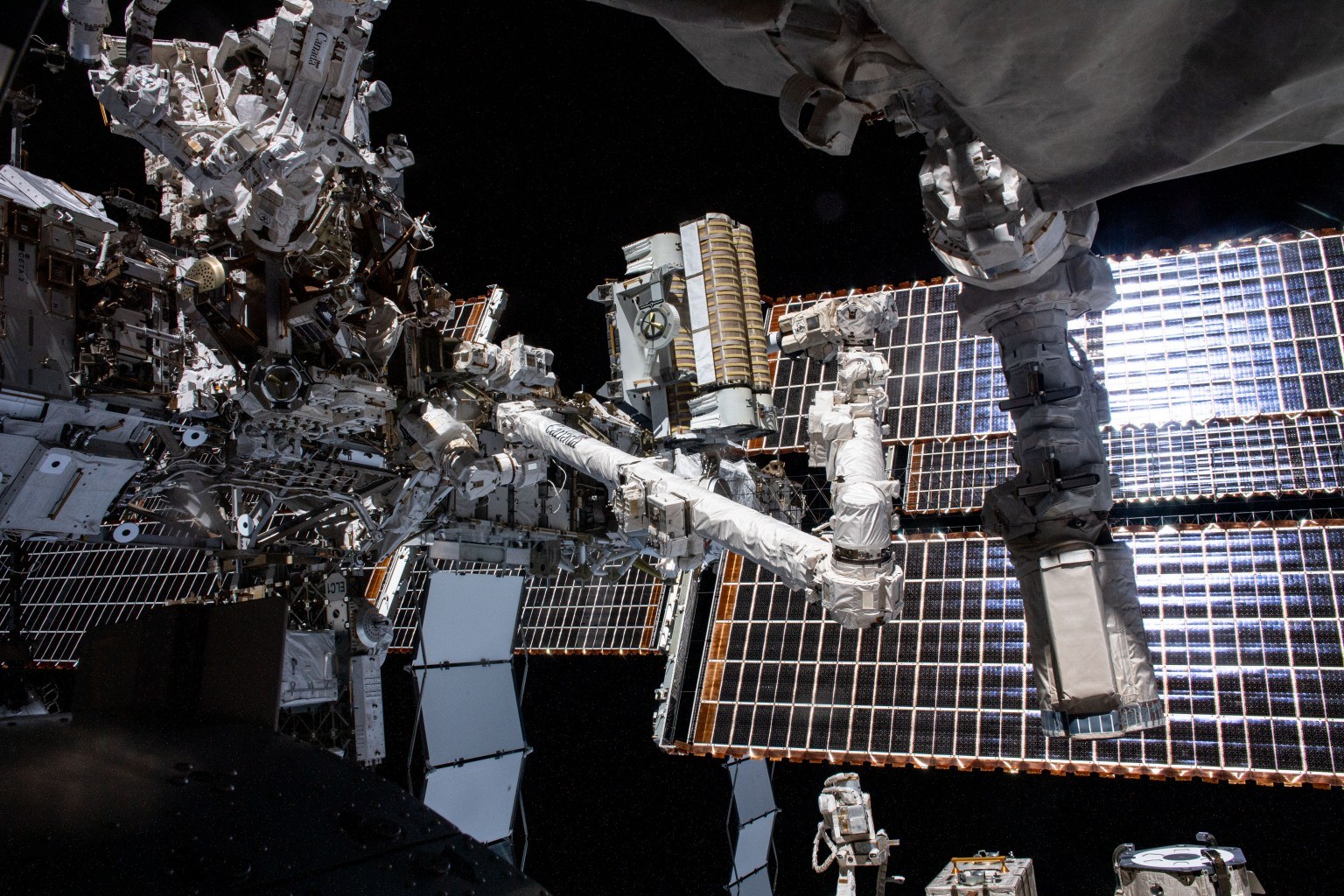
Solar energy supports life-support systems, daily activities, and hundreds of investigations on the International Space Station (ISS), according to NASA. The agency says that over the past five years, it has expanded the station’s electricity generation and distribution capacity with a new generation of deployable solar arrays known as IROSA.
In 2017, a technology demonstration aboard the station tested the effectiveness of these arrays. NASA describes their design as lightweight and compact: they are launched in the form of a cylinder and deployed after installation, like a mat. The agency says this design reduces mass and volume during launch, and that the autonomous self-deployment system minimizes risks during deployment.
NASA credits Redwire with the design, manufacture, and testing of the IROSA arrays, under contract with Boeing. The arrays are approximately half the size of the station’s previous arrays and, despite being smaller, can produce about 28 kilowatts of additional power.
Six IROSA arrays were installed on the outside of the station between 2021 and 2023. NASA says that in 2023, power projections prompted a request for another set. The agency says it was launched in the cargo compartment of a Dragon spacecraft during SpaceX 35, a commercial resupply services mission to the station. Together, the eight IROSA arrays will increase power for research and operations by more than 160 kW, according to NASA.
The agency presents the ISS as a test bed for technologies related to planetary defense and future exploration beyond Earth orbit. It mentions the Double Asteroid Redirection Test (DART) demonstration as an example.
From mechanical deployment to light conversion
The roll-out design addresses a space-transport constraint: carrying a deployable surface within limited launch volume. This mechanical advantage should not be confused with cell efficiency. These are distinct design levels, and each requires its own measurements.
The DOE explanation of photovoltaic cells describes the conversion of radiation into electricity using semiconductor materials. The light that reaches a cell, the portion it absorbs, and the electricity it delivers are not identical quantities. The rest of the energy balance includes unused radiation and other processes; a panel does not transform all incident energy into useful current.
Kilowatts, energy, and operational capacity
Kilowatts express power. They are not an amount of accumulated energy: to obtain the latter, power must be considered over an interval. That is why the figure of more than 160 kW reported by NASA should not be directly converted into daily energy without an operating profile and a definition of the conditions.
The article also mentions approximately 28 kW of additional power for the arrays. Multiplying this figure by eight does not automatically reconstruct the system’s net improvement. The announcement describes a system that combines new and previous components, with an integration approach that cannot be reduced to adding up isolated nominal ratings.
The DOE reference on performance and efficiency provides the vocabulary needed to avoid confusing a comparison of area with one of performance. Saying that the design is smaller and provides power does not, by itself, establish an efficiency percentage. Incident power, relevant area, and test conditions are needed.
Demonstrating a technology and using it in service
The 2017 demonstration and the subsequent installations occupy different places in development. A test allows operation to be examined; use in infrastructure also requires integration, operation, and maintenance. The phrase test bed does not mean that any result from the station can be transferred unchanged to another mission.
The documentation used here does not provide an hourly generation series or a complete accounting of all the station’s electrical loads. Drawing a production curve from the announced power ratings would give the appearance of observations we do not have. That is why a diagram of stages and a table of quantities are shown, together with the limitations of each.
What information we need to compare
A technical comparison should preserve what was measured, at which system level, and in what deployment state. It should also distinguish projected capacity from performance already recorded in operation. The announcement credits specific organizations with the design and its integration; this explanation is not an independent evaluation of their products.
The described improvement matters because electricity supports operations and experiments. The next scientific question is how the integrated system performs and what evidence of its operation is published. Keeping these two scales—device and system—together helps explain the advance without turning an institutional announcement into a complete performance specification.
| Data or expression | Correct interpretation | Additional data needed for comparison |
|---|---|---|
| More than 160 kW of additional power projected | Reported power increase for eight IROSA arrays | Conditions and configuration of the integrated system |
| Approximately 28 kW | Additional performance cited in the article | The object and conditions to which it applies |
| Smaller deployment size | Geometric and mechanical characteristic | Reference area and comparable performance |
| Energy produced | Power integrated over an interval | Generation time profile, not just a nominal figure |
Explore the explanation
Stages of the roll-out design in NASA’s announcement
- Demonstration
Technology test aboard the station in 2017.
- Integration
Installation of six IROSA arrays between 2021 and 2023, according to NASA.
- Expansion
Another set transported to expand capacity.
- Complete system
Reported target of more than 160 kW of additional power for eight arrays.
Conceptual sequence; the final power-increase target is not presented as a series of operational measurements.
What we know and its limits
The information comes from a NASA institutional announcement and is not independently corroborated here. The excerpt does not specify the installation date of the second set or provide power measurements or the operational status of each array.
One of the keys has been corrected: 2023 refers to the request for the additional set, not its launch date. Correction corroborated against NASA’s institutional excerpt. 19/10/2026: Context is expanded, new references are cross-checked, and resources with their provenance are added. The original publication date is retained. AI-assisted production and automated checks; no human review.
Follow the evidence
The original sources for exploring this explanation and its limits.
- Solar Photovoltaic Cell Basics
U.S. Department of Energy
Photovoltaic conversion and semiconductor families. - Solar Photovoltaic Performance and Efficiency Basics
U.S. Department of Energy
Optical losses, recombination, temperature, and efficiency measurement. - Power Up: Roll Out Solar Arrays Boost Space Station Power Supply
NASA
NASA institutional communication. The excerpt from the official channel is retained in the editorial file for comparison.