





Key ideas
- A natural hydrothermal system needs heat, fluid, and permeability; EGS is intended for areas where the rock is hot but there is not enough fluid or permeability.
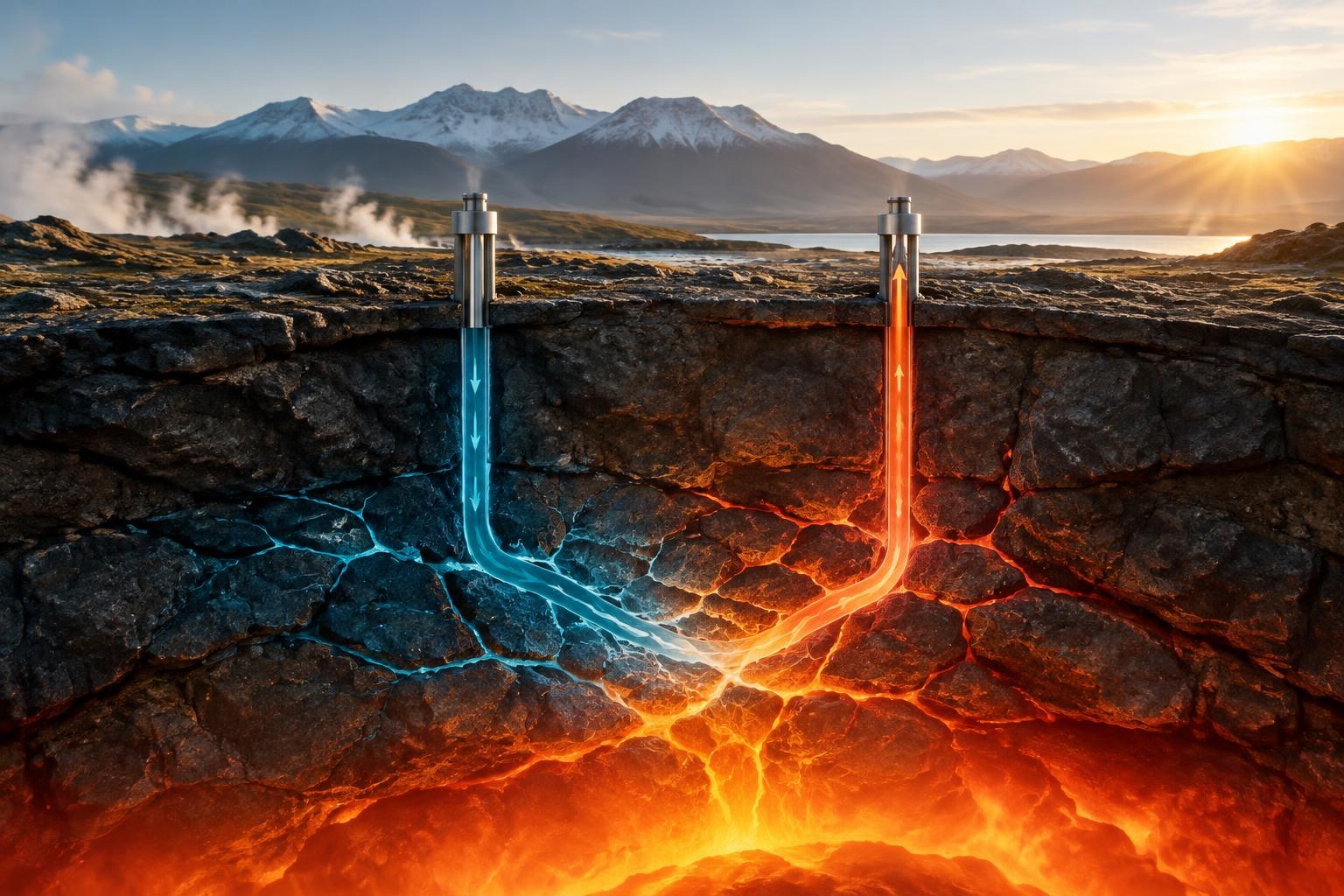
- In EGS, controlled injection creates fractures and reopens others, allowing fluid to circulate through the hot rock and carry heat to the surface to generate electricity.
- Viability depends, among other factors, on subsurface characteristics, fracture control, well construction and evaluation, monitoring, and costs.
What a geothermal system needs
Geothermal energy harnesses heat from inside the Earth. Generating electricity in a natural hydrothermal system requires three elements: heat, fluid, and permeability—that is, the ability of fluid to move through underground rocks. The general information from the U.S. Energy Information Administration (EIA) puts this heat in the context of the Earth's energy: rocks and water absorb heat from the subsurface, and, in general, temperature increases with depth (EIA: geothermal energy).
The challenge addressed by enhanced geothermal systems (EGS) is that some areas have hot rock, but not enough natural fluid, or the fractures do not allow it to circulate easily. The U.S. Department of Energy explains that, under these conditions, an EGS can create an artificial reservoir to extract the heat. The idea is not to produce heat, but to make it easier for a fluid to collect heat from the rock and carry it to the surface.
How the reservoir is created and used
According to the U.S. Department of Energy, fluid is injected deep underground under controlled conditions to open existing fractures and create new ones. This increase in permeability allows the fluid to travel through a larger portion of the hot rock. As it circulates, it heats up; it is then pumped to the surface, where the hot water generates electricity for the grid (U.S. Department of Energy: enhanced geothermal systems).
The process depends on several components working together: the rock must provide heat; the fractures must allow fluid to move; and the wells must connect the reservoir to the surface. Permeability is therefore not an incidental detail: it determines whether the fluid can circulate through the rock and collect heat. The Department of Energy source notes that an initiative on hydraulic properties aims to develop technologies and techniques to control flow within the fracture network and optimize heat extraction. Separately, methods under development to modify fracture permeability could increase the reservoir's efficiency and lifespan, reduce costs and risks, and accelerate commercialization.
Once the hot fluid reaches the surface, electricity conversion depends on the power plant configuration. The EIA describes three basic types of geothermal power plants: dry steam plants use steam from the reservoir directly to turn a turbine; flash steam plants reduce the pressure of hot water so that some of it turns into steam; and binary cycle plants transfer heat to another liquid, which vaporizes and drives the turbine (EIA: geothermal power plants). This classification provides context for understanding geothermal generation, but does not in itself establish which configuration is used in each EGS project.
| Aspect | Natural hydrothermal system | Enhanced geothermal system (EGS) |
|---|---|---|
| Conditions described | Natural heat, fluid, and permeability | Hot rock with insufficient fluid or limited natural permeability |
| How fluid circulates | Through existing permeability | Controlled injection creates new fractures and reopens some existing ones |
| Heat extraction | Hot fluid is brought to the surface | Fluid circulates through fractured rock, heats up, and is pumped to the surface |
| Documentary basis | General requirements for a hydrothermal system | U.S. Department of Energy's description of EGS |
The comparison summarizes the conditions and mechanism described by the U.S. Department of Energy; it does not represent an assessment of the relative performance of the two systems.
What shapes its development
The possibility of building an artificial reservoir does not eliminate drilling and operational challenges. The U.S. Department of Energy indicates that economic viability depends on improving technologies and subsurface knowledge, including geological properties and permeability. It also identifies well construction as a technical and cost challenge. In particular, well casing and cementing materials and operations account for around 30 % to 40 % or more of total well costs, according to the source. The Department notes that commercially available solutions for evaluating casing and cementing are not generally considered suitable for higher-temperature geothermal systems.
Seismic monitoring also presents challenges. The U.S. Department of Energy describes seismic sensors that collect data on geothermal reservoirs and subsurface conditions, information essential for developing effective and efficient EGS. However, traditional seismic monitoring tools may not withstand the high temperatures, high rock strength, and corrosive fluids found in geothermal wells. The Department describes research and demonstration initiatives to improve technologies, test systems in different geological environments, and advance toward commercial viability. The existence of these projects does not mean that the technology has already been shown to be commercially viable everywhere.
EGS and other advanced geothermal technologies
EGS is not the only next-generation geothermal technology presented by the Department of Energy. Closed-loop systems, for example, do not depend on a fracture network: they use a series of closed underground pipes through which water and working fluids circulate to absorb heat from the subsurface and carry it to the surface. Superhot systems harness resources at >375 °C; the source indicates that water injected into these environments can acquire properties of both a liquid and a gas and carry large amounts of thermal energy.
These technologies take different approaches. EGS aims to make fluid circulate through fractured rock; closed-loop systems transfer heat through pipes without depending on fractures; and superhot systems are defined by the resource's temperature. The Department notes that next-generation geothermal technologies could extend development beyond traditional hydrothermal regions. It presents this expansion as a possibility, not a guaranteed outcome: it depends on subsurface conditions, technological development, and economic viability.
In short, EGS seeks to make heat accessible where the rock is hot but natural fluid or permeability is insufficient. The sequence—inject, facilitate circulation, heat the fluid, and bring it to the surface—explains the system's principle; well construction, fracture control, monitoring, and costs define the challenge of turning that principle into a power source suitable for different environments.
What we know and its limits
The explanation is based primarily on an institutional page from the U.S. Department of Energy and uses two EIA pages as context on geothermal energy and types of power plants. These sources describe principles, challenges, and initiatives, but do not provide an independent assessment here of EGS performance, final costs, or commercial viability at specific sites. The recorded date corresponds to when the pages were consulted, not to the publication of a finding.
Follow the evidence
The original sources for exploring this explanation and its limits.
Image credits
SciClue · AI-generated illustration (OpenAI) · Original source · Recurso editorial de SciClue · generado con IA