





Key ideas
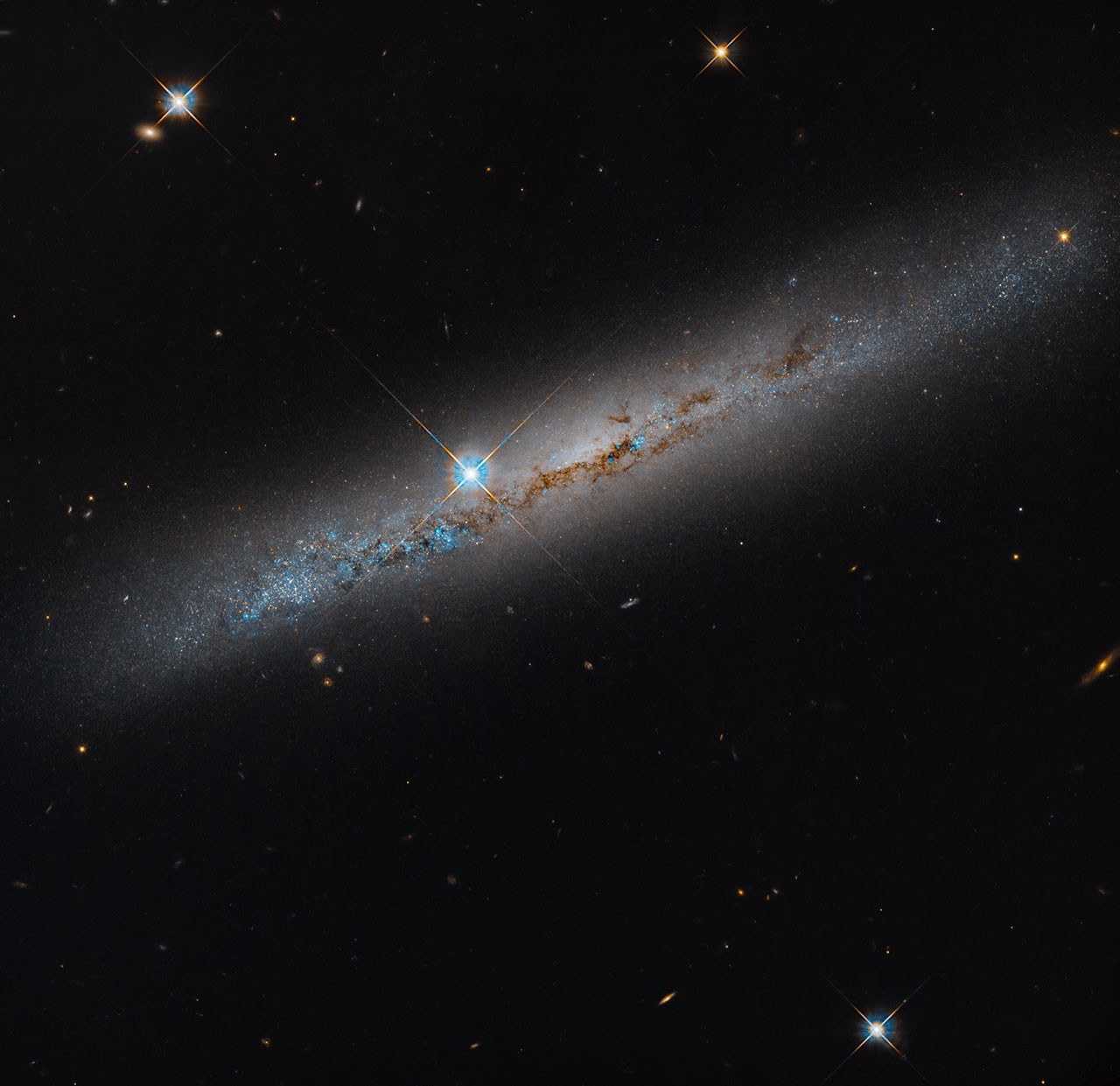
- NGC 1827 is an intermediate spiral galaxy observed edge-on, located about 37 million light-years away, according to NASA.
- The image shows bright blue regions speckled with dark dust lanes; NASA notes that stars are probably forming there.
- The survey covers 260 satellite galaxies around 22 hosts similar to the Milky Way. Hubble has observed 111; observing the remaining 149 will require 149 orbits, one per galaxy.
What the observation shows
An image from the Hubble Space Telescope shows NGC 1827, an intermediate spiral galaxy observed edge-on in the constellation Columba, the Dove. NASA’s report says it is located about 37 million light-years away. The image was taken with Hubble’s Advanced Camera for Surveys.
The image reveals bright blue regions along the galaxy’s disk, speckled with dark dust lanes, where stars are probably forming, according to NASA’s description. To the left of the bright central bulge is a foreground star, located between us and the galaxy. Its four diffraction spikes are caused by light bending around the internal struts that support Hubble’s secondary mirror.
The report places these observations in a program studying 260 satellite galaxies in systems similar to the Milky Way. Hubble has already observed 111 of these galaxies. NASA says that observing the remaining 149 galaxies will require another 149 Hubble orbits, one for each galaxy.
NASA explains that the program’s low-mass galaxies make it possible to test predictions of cosmological models on small scales, where those models have difficulty agreeing with observations. The data collected by Hubble will help better understand and characterize the properties of low-mass galaxies in systems similar to the Milky Way, and allow researchers to refine cosmological models.
A galaxy seen from another direction
The edge-on orientation describes the relationship between our line of sight and the galactic disk. It does not describe a different category of object or mean that the galaxy has changed shape. A disk observed nearly edge-on concentrates structures into a narrow band; it does not provide the same visual view of the arms as a face-on view.
NASA’s galaxy guide provides context for distinguishing spiral disks, stars, and other components. Here it helps interpret the geometry, not as a second analysis of NGC 1827. Classifying an image and explaining the evolution of a galaxy are related tasks, but they require different evidence.
Dust should not be confused with a gap devoid of matter, either. By dimming some of the light, it contributes to the image’s dark lanes. Saying that a blue region probably contains star formation preserves the caution of the original report: color guides an interpretation, but this article does not provide a catalog of stellar ages or a measured star-formation rate.
The optics also appear in the image
NASA explains Hubble’s mirror system: the primary mirror collects light, the secondary mirror redirects it, and the instruments analyze it. The result depends on this optical chain. The spikes around a bright star are a good reminder that an astronomical image contains information about the sky and effects from the instrument.
That is why the four spikes do not mean the star physically has that shape. Nor do they place the star inside the galaxy: the report explicitly identifies it as a foreground object. Separating the observed object from the telescope’s response prevents turning a feature of the recording into an invented property of the celestial body.
What an observing program contributes
The program aims to assemble a sample of low-mass galaxies to compare cosmological models with observations on small scales. Its purpose is not to declare that a photograph solves the problem. A sample makes it possible to compare properties, look for patterns, and examine whether the model adequately describes the group as a whole.
The numbers in the accompanying chart correspond to the program status described in the report: 111 targets observed and 149 pending. They are not a census of all existing satellite galaxies or a measure of a model’s success. The number of remaining orbits to be allocated describes observing needs, not a galaxy’s age or distance.
To follow the scientific result, it will be necessary to examine the data and studies arising from the survey. This article includes contextual references from the same organization, but no independent verification of the analysis or publication reporting all its uncertainties.
| Feature in the record | Supported interpretation | What it does not demonstrate |
|---|---|---|
| Narrow disk | Orientation close to an edge-on view | That the galaxy is a line with no thickness |
| Dark lanes | Dimming associated with dust | Absence of matter |
| Star with spikes | Foreground object and instrumental diffraction | A physical four-pointed shape |
| Bluish regions | Possible star formation according to NASA | A numerical rate of star formation |
Explore the explanation
Survey status described by NASA
View data and units
| Category or period | Value (galaxias) |
|---|---|
| Observed | 111.00 |
| Pending | 149.00 |
Program count in the report consulted on 19/10/2026: 111 observed and 149 pending out of a planned total of 260. This is not a census of the universe or an estimate of physical completeness. Scale from zero.
What we know and its limits
The synthesis is based solely on a NASA institutional excerpt and has not been independently corroborated. Interpretations and projections are attributed to NASA; no additional information is available to assess them separately.
19/10/2026: Context expanded, new references cross-checked, and resources with their provenance added. The original publication date is retained. AI-assisted preparation and automated checks; no human review.
Follow the evidence
The original sources for exploring this explanation and its limits.
- NASA’s Hubble Spies Spiral’s Edge
NASA
NASA institutional communication. The excerpt from the official channel is retained in the editorial file for comparison. - Galaxies: Shapes and Components
NASA
Reference consulted to expand and cross-check the explanation. Its role and limitations are indicated alongside the content. - Hubble Optics: The Journey of Light
NASA
Reference consulted to expand and cross-check the explanation. Its role and limitations are indicated alongside the content.
Image credits
NASA, ESA, Michael Jones (Caltech); processing: Gladys Kober (NASA/CUA) · Original source · NASA/ESA Hubble · uso editorial con crédito