





Key ideas
- MMX, a JAXA mission, aims to characterize Phobos and Deimos and bring a sample from Phobos to Earth.
- MEGANE will measure neutrons and gamma rays emitted from Phobos; the P-Sampler is designed to collect surface material.
- NASA will provide communications and navigation support, fund participating scientists, and curate approximately 15 % of the total sample.
The mission and NASA's contribution
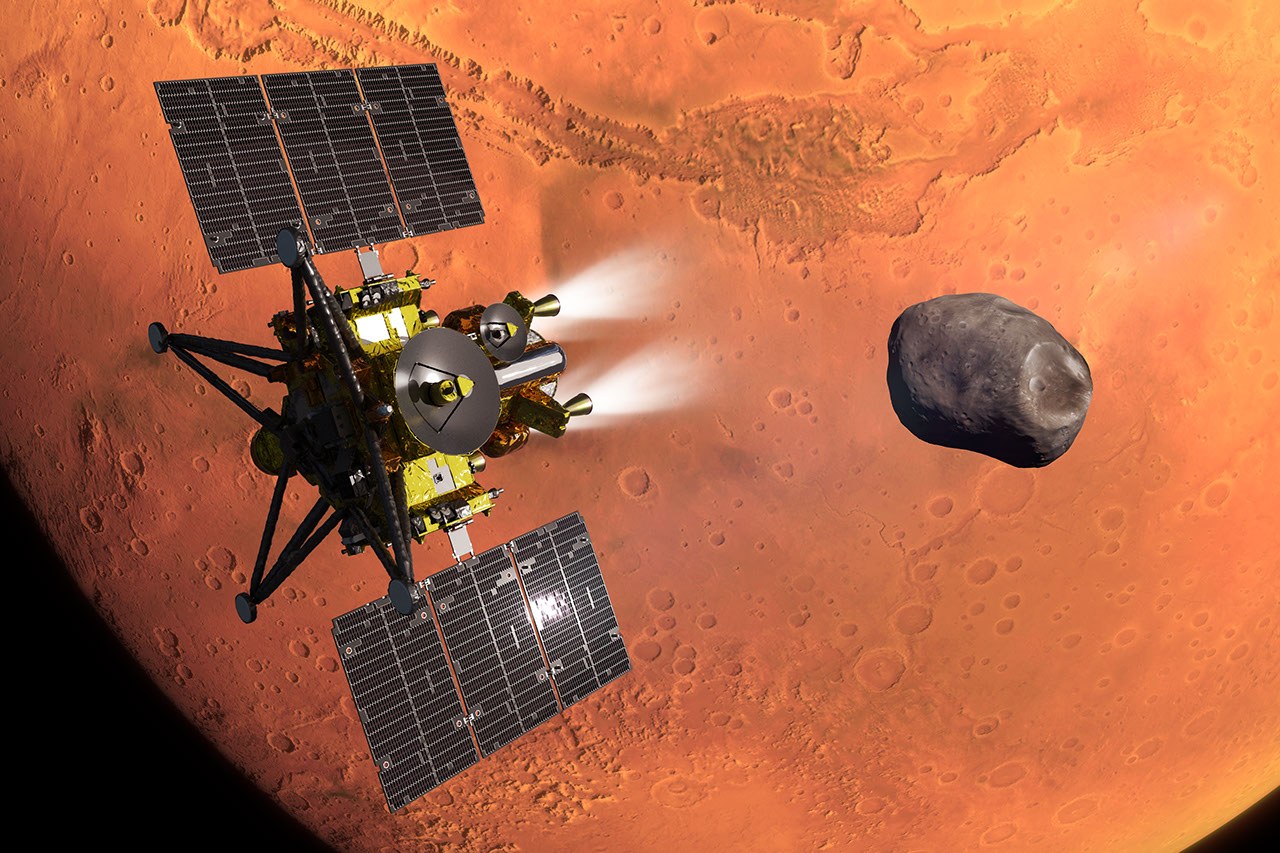
The Japan Aerospace Exploration Agency's (JAXA) MMX (Martian Moons eXploration) mission aims to characterize Phobos and Deimos, investigate their origin, and bring a sample from Phobos to Earth. NASA will contribute instruments, communications and navigation support, and funding for U.S. scientists participating in the mission's science team.
One of these contributions is MEGANE, a spectrometer that will measure neutrons and gamma rays emitted from Phobos's surface to determine its elemental chemical composition. NASA is also providing the P-Sampler, a technology demonstration installed on a landing leg and designed to collect surface material using pulses of high-pressure nitrogen. It will complement JAXA's C-Sampler, which will extract samples from areas deeper below the surface. NASA will acquire and curate approximately 15 % of the total sample in the extraterrestrial materials laboratory at the Johnson Space Center in Houston and make it available for research for decades.
The origin of Phobos and Deimos is still debated. NASA describes two possibilities: that they are remnants of a large impact on Mars, or ancient asteroids captured by the planet's gravity. MMX data and samples could help investigate these hypotheses and the history of the solar system.
Why study Phobos and Deimos?
NASA's guide to the moons of Mars describes Phobos and Deimos as small bodies with irregular shapes. Their appearance alone does not resolve how they originated. Distinguishing the capture of bodies from elsewhere from formation associated with impacts requires evidence of composition and orbital context, not just visual resemblance.
A sample provides different information from a photograph: it allows laboratory techniques to be applied to material with documented provenance. But analyzing a few grains is not the same as observing the entire interior of a moon. The selection of the collection site and the relationship between the sample and its surroundings are part of the scientific argument.
Instruments that address complementary questions
JAXA's MMX documentation describes an exploration and sample-return mission. Observing from the spacecraft, inspecting a surface, and collecting material are complementary operations. The MEGANE instrument, mentioned by NASA, uses gamma rays and neutrons to investigate elemental composition; it should not be described as a camera that directly photographs the satellite's history.
The pneumatic sampler provided by NASA and JAXA's collection system are also not interchangeable: they use different procedures and provide different acquisition contexts. The most useful comparison is to identify what material each technique obtains and how its traceability is preserved. Without this information, a list of instruments cannot be turned into a conclusion about the origin of Phobos.
A schedule is a forecast
JAXA presents phases for travel, observation, collection, and return. Future milestones should be read as mission objectives, subject to operational considerations and schedule revisions. An announced contribution or a completed instrument does not demonstrate that material has already been collected or that a laboratory conclusion exists.
Sample traceability links these phases: place of origin, collection method, storage, return, and allocation. If this context is lost, a chemical measurement may remain precise but be less able to answer the geological question. The reference to the planned allocation of samples also does not allow us to infer results from an analysis that has not yet been performed.
What results would allow progress?
Comparing composition, surface characteristics, and recovered material may test explanations for the moons' origin. A difference between techniques may indicate material heterogeneity or the limits of a measurement; it would be unwise to choose a winning hypothesis in advance.
The term sample return describes an objective and a technical sequence. To assess its scientific success, we will need to know what was obtained, in what context, and what results the teams publish. These references come from the mission agencies: they expand the record but do not constitute an independent review of future results. The table separates the functions so readers can follow what evidence each stage provides.
| Resource or stage | Question addressed | Limit of interpretation |
|---|---|---|
| Remote observation | How the surface and composition vary as seen from the spacecraft | Does not replace all laboratory analyses |
| MEGANE | Elemental composition based on gamma rays and neutrons | Does not determine the moons' origin on its own |
| Material collection | What a sample from a known context contains | Is not equivalent to sampling the entire satellite |
| Analysis on Earth | What properties the recovered materials show | Depends on collection, preservation, and methods |
Explore the explanation
From mission objective to laboratory evidence
- Recognize
Observe the moons and identify study targets.
- Characterize
Relate remote measurements to surface context.
- Collect and preserve
Document how and where the material was obtained.
- Return and analyze
Compare laboratory results with hypotheses about origin.
Planned conceptual phases: the diagram does not indicate that they have already been completed. Consult the agencies’ current schedule.
What we know and its limits
The summary is based solely on an excerpt from an institutional NASA communication, without independent corroboration or independent peer review. The mission details have not been independently verified.
19/10/2026: Context expanded, new references cross-checked, and resources with their provenance added. The original publication date is retained. AI-assisted preparation and automated checks; no human review.
Follow the evidence
The original sources for exploring this explanation and its limits.
- NASA to Help Unlock Mysteries of Mars’ Moons in Upcoming Mission
NASA
NASA institutional communication. The excerpt from the official channel is retained in the editorial file for comparison. - MMX: Mission Objectives and Phases
JAXA
Reference consulted to expand and cross-check the explanation. Its role and limitations are indicated alongside the content. - Phobos and Deimos: Moons of Mars
NASA
Reference consulted to expand and cross-check the explanation. Its role and limitations are indicated alongside the content.
Image credits
JAXA · MMX artist's concept; distributed by NASA · Original source · JAXA · uso informativo de prensa con crédito, sin recorte