





Key ideas
- Fission of uranium atoms releases heat and neutrons that can sustain a chain reaction; the heat is used to produce steam and electricity.
- In the light-water reactors described by the Department of Energy, water acts as a coolant and moderator, and control rods can reduce or increase the reaction rate.
- PWRs produce steam in a separate circuit using a heat exchanger; BWRs generate steam inside the reactor vessel and route it to the turbine.
From Fission to Heat
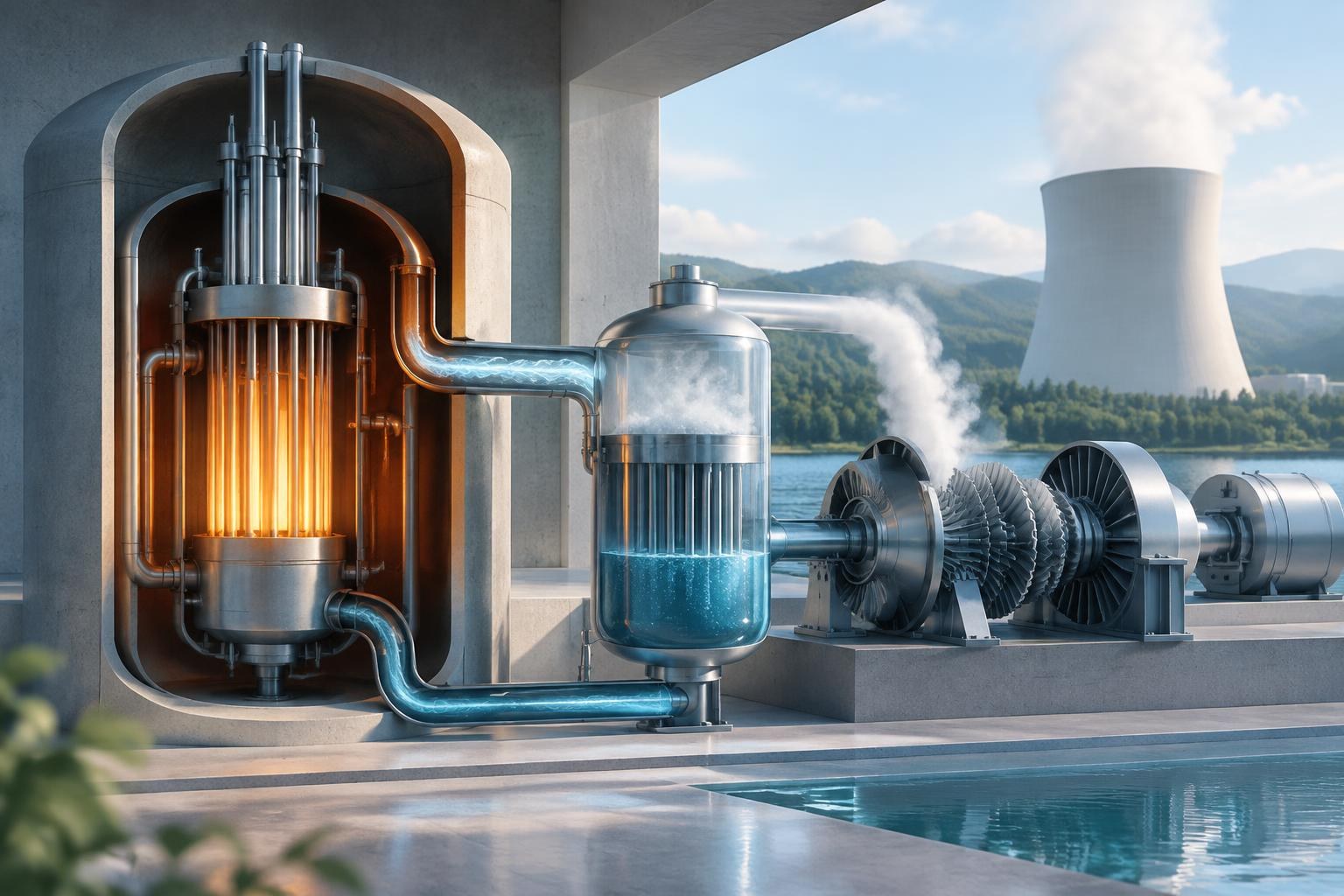
In a nuclear power plant, electricity is generated by harnessing the heat produced by fission. According to the U.S. Energy Information Administration (EIA), a neutron can collide with a large atom, excite it, and split it into two smaller atoms, called fission products. The process releases energy and additional neutrons, which can initiate new fissions and sustain a chain reaction.Primary source: EIA
The fuel described by EIA is made from uranium ore: it is mined and processed to produce small ceramic pellets. The pellets are stacked into fuel rods, which are loaded into assemblies in the reactor core. The heat generated there is transferred to water and enables steam to be produced. The rods, assemblies, and core are part of the system that contains the fuel while fission takes place.
The energy conversion chain can be summarized as follows: fission → heat → steam → turbine → electric generator. Steam spins the blades of a turbine; the turbine drives a generator that produces electricity using magnets.EIA Energy does not pass directly from the fuel to the grid: it is first converted into heat and then into mechanical motion before becoming electricity.
How the Chain Reaction Is Regulated
The reactor must house and control fission to produce heat in a regulated way. The U.S. Department of Energy’s technical reference explains that, in the light-water reactors it describes, water serves two functions: coolant, because it carries heat, and moderator, because it slows the neutrons produced by fission and helps sustain the chain reaction. Control rods can be inserted into the core to reduce the reaction rate or withdrawn to increase it.U.S. Department of Energy
This explanation clarifies the control mechanism, but the EIA excerpt does not detail the control rods or describe protective systems or operating procedures. Therefore, a general description of how the reaction is regulated should not be confused with a complete explanation of a power plant’s safety.
Two Designs and Two Paths for Water
The Department of Energy distinguishes two types of light-water reactors operating in the United States: pressurized water reactors (PWRs) and boiling water reactors (BWRs). In both, ordinary water acts as a coolant and moderator, but the path of the water and steam differs.U.S. Department of Energy
| Aspect | Pressurized water reactor (PWR) | Boiling water reactor (BWR) |
|---|---|---|
| What happens in the core | The water is kept at high pressure to prevent it from boiling. | The water is heated and produces steam inside the reactor vessel. |
| How steam for the turbine is generated | The heated water flows through tubes in a heat exchanger, which transfers heat to a separate water circuit. | The steam produced in the vessel is routed directly to the turbine. |
| What happens after the turbine | The excerpt does not specify the steam’s subsequent path. | Unused steam is condensed and the water is reused in the process. |
The table summarizes the differences described in the Department of Energy reference; it does not imply that both designs have identical components or operation. The source states that more than 65% of U.S. commercial reactors are PWRs and approximately a third are BWRs. These proportions refer to reactors in the United States according to the reference text, not the global fleet.U.S. Department of Energy
Cooling and Energy Context
The steam that drives the turbine is part of a thermal process, and power plants also have to manage heat through cooling systems. EIA indicates that some plants use water from lakes, rivers, or oceans and that not all have cooling towers. It also states that U.S. reactors may have large concrete domes over the reactors, required to contain accidental releases of radiation.EIA This description does not support the conclusion that all plants have the same design, nor does it provide enough detail to assess the safety measures of a particular facility on its own.
For context, EIA classifies nuclear energy as nonrenewable and explains that it is produced by splitting uranium atoms to generate heat and, ultimately, electricity. The same reference indicates that uranium is distributed throughout Earth’s crust, but much of it is too difficult or costly to mine and process for use as fuel.EIA, energy sources This classification and description of the resource help put the technology in context, but do not constitute a comparative assessment of its impacts or performance relative to other sources.
Overall, basic operation depends on three linked stages: fission releases energy in the core, the reactor design regulates the reaction and transfers heat, and steam spins the turbine connected to the generator. In the available explanation, the difference between PWRs and BWRs lies in how the water is heated and where the steam that reaches the turbine is produced.
What we know and its limits
The explanation is based on institutional excerpts from EIA and the U.S. Department of Energy, not on an independent peer review. EIA’s main reference describes general operation, fuel, some cooling options, and generation and capacity data for specific dates; it does not cover reactor control in detail or allow assessment of safety, environmental impacts, costs, or the life cycle. The description of PWRs and BWRs comes from a contextual source and refers to light-water reactors in the United States. Capacity and generation figures cited by the sources correspond to specific periods and should not be interpreted as current data.
Follow the evidence
The original sources for exploring this explanation and its limits.
-
Sources of energy
EIA
Institutional reference for context. It does not constitute independent confirmation of the main source's findings. - Nuclear energy: how a reactor works U.S. Department of Energy
- Nuclear power plants: how fission is controlled and harnessed EIA
Image credits
SciClue · AI-generated illustration (OpenAI) · Original source · Recurso editorial de SciClue · generado con IA