





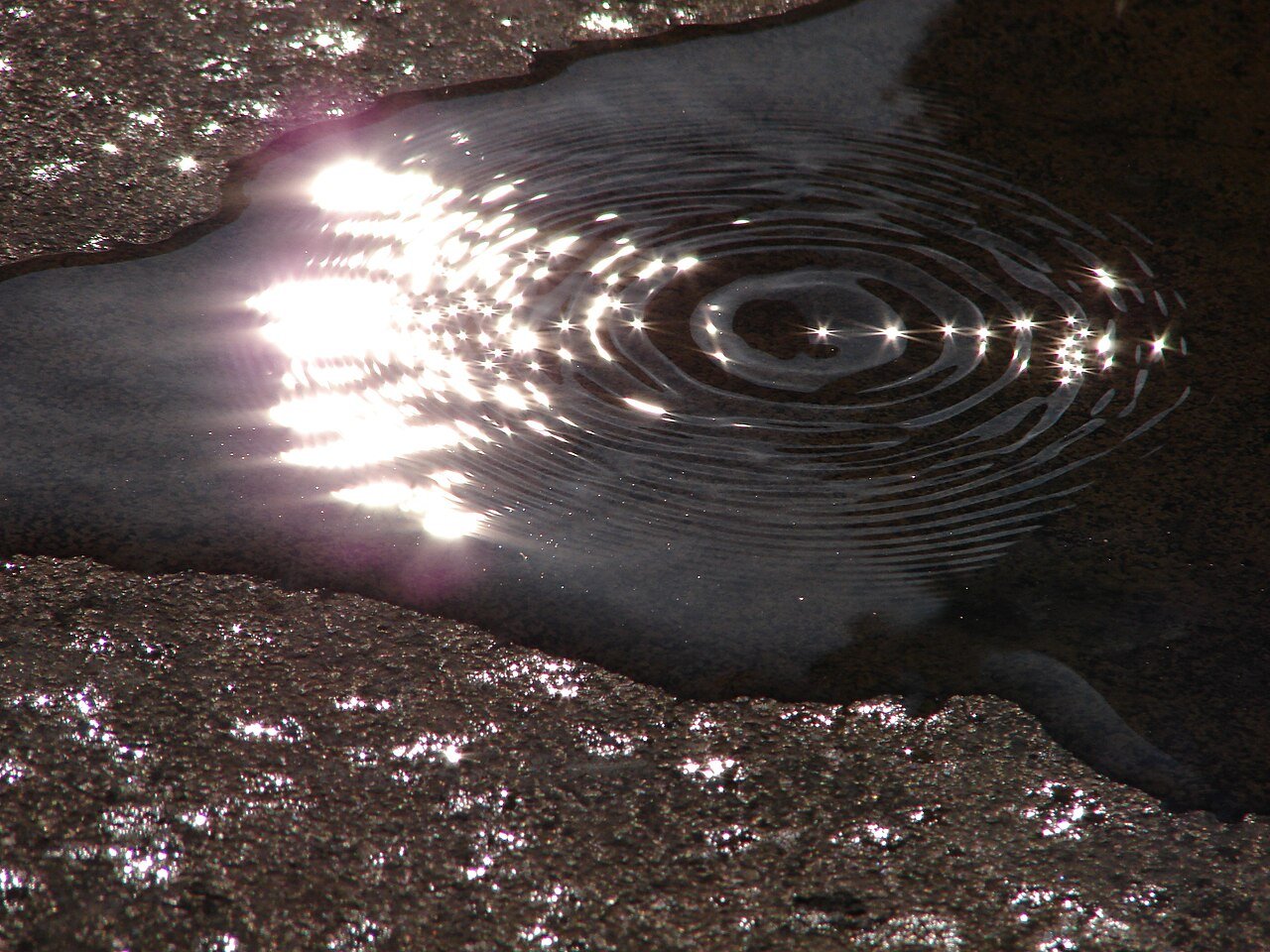
Key ideas
- The local motion of the medium and the advance of the disturbance are different.
- The relationship v = f × λ connects frequency, wavelength, and phase velocity.
- The energy transported depends on the system and the model conditions.
We shake one end of a string and see a pulse move forward. A mark painted on the string moves near its position, while the disturbance continues toward the other end. This observation contains the idea that makes waves useful: a signal and energy can propagate without every part of the medium traveling the entire distance.
What moves
In a mechanical wave, parts of the medium interact with their neighbors. Local motion changes forces and transmits the disturbance. The OpenStax introduction to traveling waves distinguishes the advance of the disturbance from the motion of the particles.
The phrase the medium does not travel is a useful approximation for small waves in simple situations. It should not become an absolute rule about every real wave. In fluids, there may be currents and net transport associated with phenomena that an elementary model does not include. A good explanation always states the situation in which it applies.
Four questions for describing a wave
We can ask how far a part of the medium is displaced from its equilibrium position: this leads to the displacement amplitude. We can count how many oscillations occur per second: that is the frequency. We can also measure the separation between consecutive points in the same phase, such as two crests: we obtain a wavelength.
The fourth question is how fast a phase of the disturbance advances. For a simple periodic wave, speed, frequency, and wavelength are related by v = f × λ. The OpenStax mathematical description develops these quantities. Amplitude does not appear in that identity because it answers a different question.
A small, verifiable calculation
Imagine an ideal periodic wave with a frequency of 4 Hz and a wavelength of 0,5 m. The product gives a speed of 2 m/s. This is a fictional example for practicing units: four repetitions per second, with half a meter between repetitions, correspond to two meters of advance per second.
If the speed remained the same and we doubled the frequency, the wavelength would have to be halved. The condition if the speed remains the same matters. In dispersive media, phase velocity may depend on frequency, and then we cannot simply transfer that conclusion without examining the medium.
The medium also matters
In an ideal string, tension and mass per unit length affect the propagation speed. Moving your hand faster is not enough to independently determine all the properties. The explanation of speed on a stretched string shows this relationship.
This separation between source and medium is useful beyond the string. The source produces a disturbance, while the properties of the system condition its propagation. That is why it is worth being wary of statements that attribute any observed change to a single cause without describing which conditions were kept constant.
Transverse, longitudinal, and energy
In a transverse wave, local displacement is perpendicular to propagation; in a longitudinal wave, it is parallel. A string oscillating sideways illustrates the first case. The compressions and expansions of air in simple sound illustrate the second. The distinction refers to directions, not to one wave being more powerful than another.
Transported energy requires an additional description. In specific linear models, such as an ideal string, increasing the amplitude increases the average transported power, with a quadratic dependence if the other conditions are held constant. The chapter on wave energy explains the scope of this relationship. It is not a universal formula for all wave phenomena.
How to use the model
To read an animation, we can first focus on a point in the medium and then on a crest. These are two different tracking approaches. If we only look at the whole, it is easy to confuse the speed of oscillation with the speed of advance. Drawing the two motions separately clarifies what information each quantity provides.
This model opens the door to studying sound, vibrations, and seismic signals. It also teaches a general practice: keep the conditions of an equation intact when changing examples. An explanation is more useful when it shows both what it lets us calculate and what it still does not include.
From the motion of a string to sound
The OpenStax introduction to sound lets us compare two modes of oscillation without confusing them. In sound propagating through a fluid, the disturbance is described through compressions and expansions. Local motion is oriented along the direction of propagation: it is a longitudinal wave. The string in the example shows transverse displacement relative to the signal’s advance.
These labels describe the relationship between directions; by themselves, they do not indicate how much energy a wave transports or how long it will take to arrive. The term longitudinal also does not mean that the same air molecule travels from the source to our ear. We need to keep local oscillation and propagation separate.
The table compares elementary models. In real situations, modes and reflections may coexist, so recognizing one form of motion is not enough to characterize the whole system. This comparison helps us choose which variable to observe before applying an equation.
| Model | Local motion | Advancing disturbance |
|---|---|---|
| Ideal transverse string | Displacement perpendicular to the direction of advance | Deformation of the string |
| Sound in a fluid | Oscillation parallel to the direction of advance | Compressions and expansions |
| Ideal periodic wave in the example | Repeats its phase according to frequency | v = f × λ, keeping units and conditions consistent |
Explore the explanation
What to measure in a wave
- Amplitude
Identify how much the quantity changes relative to equilibrium.
- Frequency
Count repetitions per unit of time.
- Wavelength
Measure the spatial separation between points in the same phase.
- Speed
Relate frequency and wavelength in the applicable model.
Diagram of the elementary periodic model. It is not a simulation of a real material and does not replace propagation conditions.
What we know and its limits
Linear models and ideal examples are used; currents, dispersion, nonlinearity, and real geometry may require additional treatment.
19/10/2026: Context expanded, new references cross-checked, and resources with their provenance added. The original publication date is retained. AI-assisted preparation and automated checks; no human review.
Follow the evidence
The original sources for exploring this explanation and its limits.
- University Physics Volume 1 · Traveling Waves
OpenStax · Rice University
Traveling disturbances, transverse and longitudinal waves. - University Physics Volume 1 · Mathematics of Waves
OpenStax · Rice University
Amplitude, wavelength, frequency, and speed. - University Physics Volume 1 · Wave Speed on a Stretched String
OpenStax · Rice University
Dependence of propagation on the properties of the medium. - University Physics Volume 1 · Energy and Power of a Wave
OpenStax · Rice University
Energy transfer and power in mechanical waves. - Guide to the SI · Units and Prefixes
National Institute of Standards and Technology
Derived units, names, symbols, and prefixes. - Sound Waves and Longitudinal Propagation
OpenStax
Reference consulted to expand and cross-check the explanation. Its role and limitations are indicated alongside the content.