





| Location | Between the crust and core |
|---|---|
| General state | Predominantly solid |
| Relevant scale | Deformation depends on time and conditions |
Definition and context
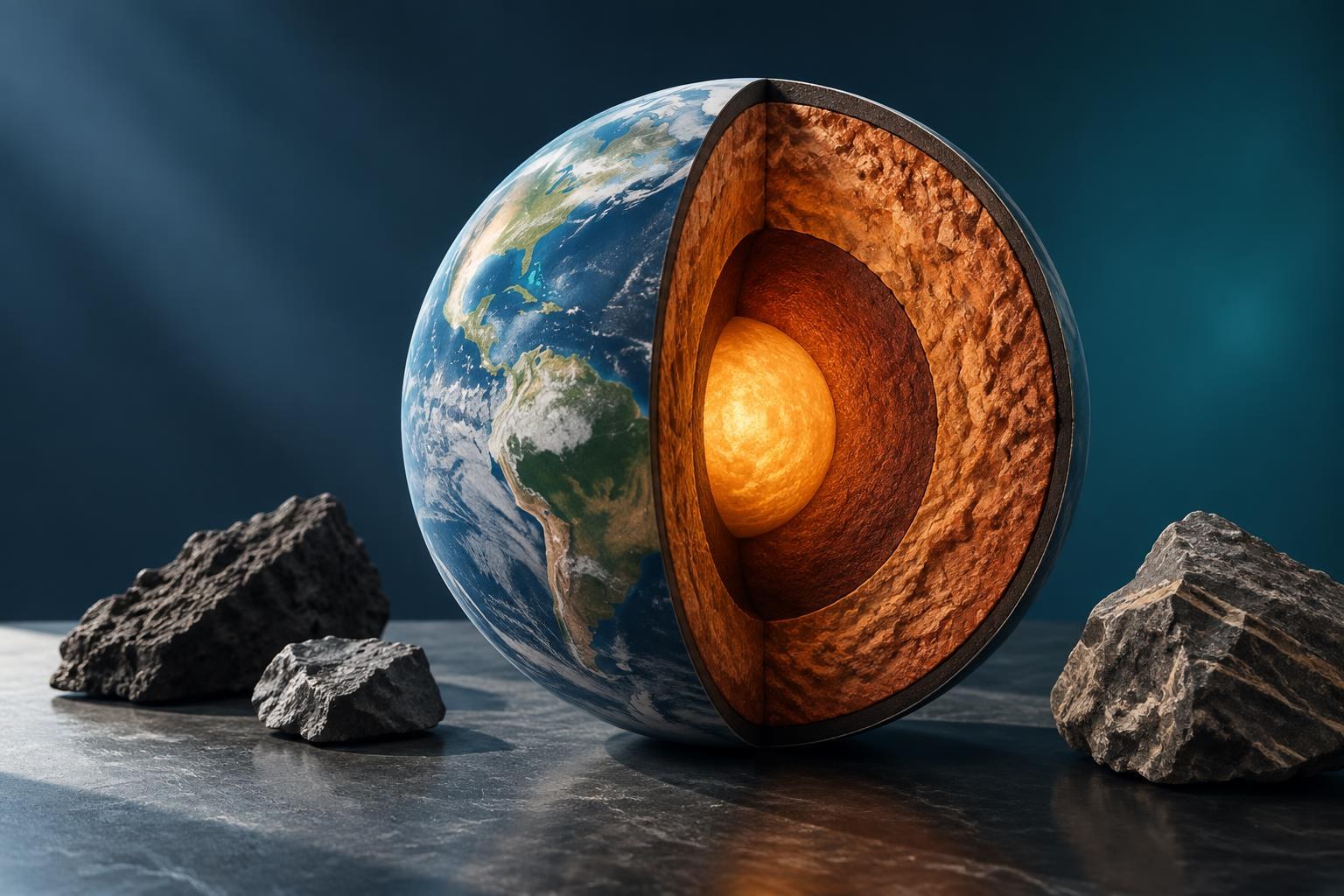
The mantle occupies the region between the crust and the core. It is composed mostly of rocky materials and should not be imagined as a global reservoir of liquid magma. Its properties change with pressure, temperature, composition, and depth.
A solid can respond differently depending on how long a stress lasts. This idea helps explain the slow deformation of mantle materials over geological time, without denying their predominantly solid nature. Experiments and seismic observations constrain models of its structure. An illustration with uniform colors simplifies a region that exhibits variations; it is useful for orientation, but does not represent every detail of the interior’s composition or dynamics.
What we know and its limits
Introductory reference sheet. Properties and applications depend on measurement conditions; consult the sources before making comparisons.
Follow the evidence
The original sources for exploring this explanation and its limits.
- The Interior of the Earth
U.S. Geological Survey
Seismic and experimental evidence about Earth's layers. - Are the tectonic plates floating on magma?
U.S. Geological Survey
Why the asthenosphere is not a global ocean of magma.
Image credits
SciClue · AI-generated illustration (OpenAI) · Original source · Recurso editorial de SciClue · generado con IA