


Key ideas
- The USGS describes 43 lava-fountain episodes between December 23, 2024, and March 10, 2026, and reports a total of 55 episodes as of October 17, 2026.
- Most of the tephra consisted of bombs and lapilli deposited less than 3 km from the vents; in some episodes, different materials reached distances of up to tens of kilometers.
- The fallout affected communities and infrastructure and prompted alerts, access restrictions, and coordinated cleanup efforts.
An eruption with lava-fountain episodes
An article by the United States Geological Survey (USGS) describes the characteristics and impacts of tephra produced during lava-fountain episodes at Kīlauea volcano in Hawaii. The paper, published in the Journal of Applied Volcanology, also examines public alerts, agency involvement, and cleanup efforts associated with volcanic fallout. The publication is based on episodes recorded between December 23, 2024, and March 10, 2026; the abstract indicates that, by October 17, 2026, the total had reached 55 episodes.
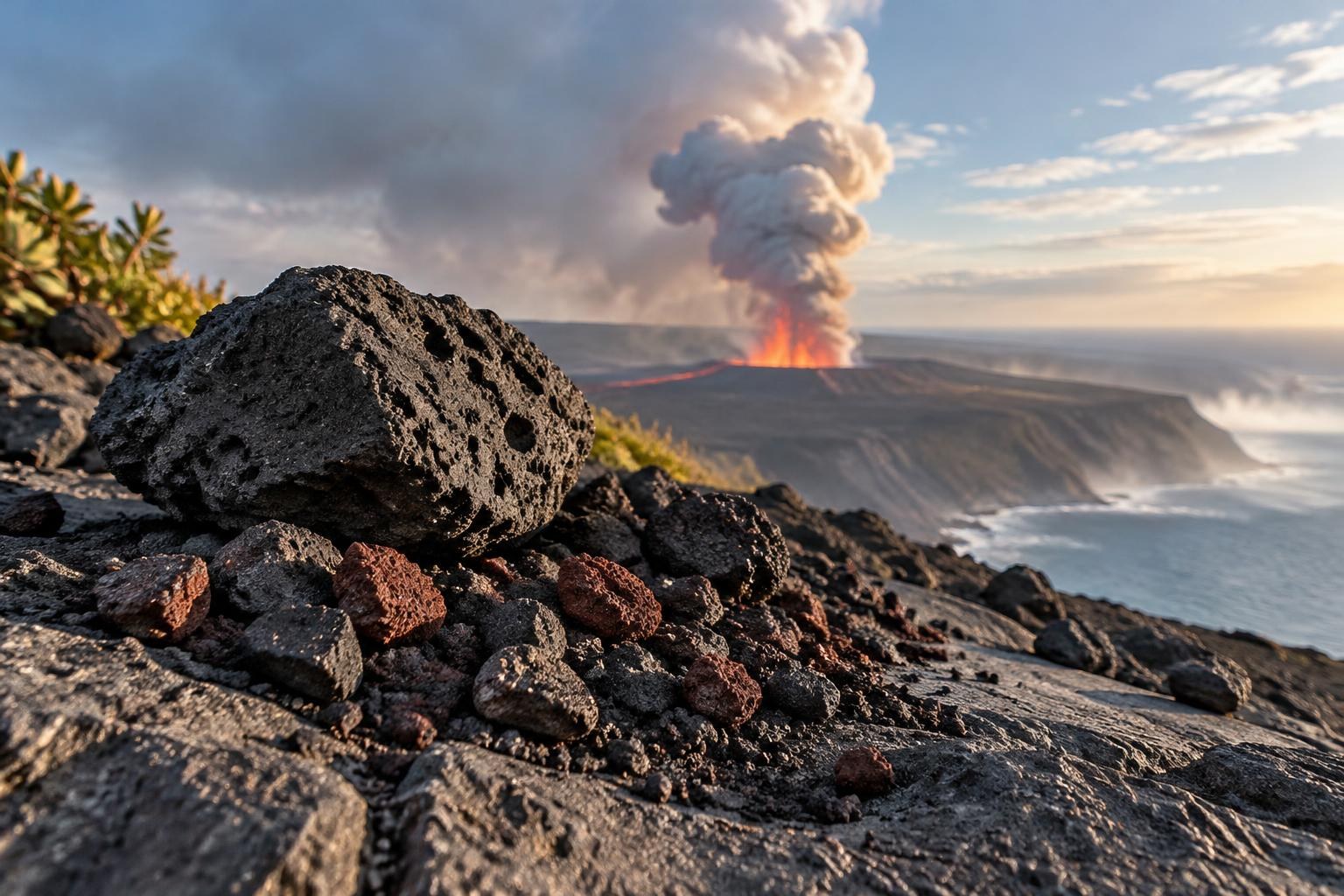
Tephra comprises fragments ejected by an eruption. According to the article’s abstract, the tephra in these episodes was basaltic in composition. Most consisted of bomb- and lapilli-sized fragments deposited less than 3 km from the vents. In some episodes, however, bombs, lapilli, ash, and Pele’s hair—volcanic filaments—reached distances of up to tens of kilometers.
The study links this more extensive distribution to a combination of factors: greater fountain heights, associated with the mass eruption rate, and changes in the height and behavior of the eruption column, associated with thermal energy and meteorological conditions during the lava fountains. The abstract does not provide specific values for these variables, so it does not allow the contribution of each factor to be quantified.
From nearby fragments to extensive dispersal
The difference between nearby deposits and materials that traveled farther is important for understanding the reach of the episodes described. Coarse tephra—bombs and lapilli—was concentrated mainly near the vents, but the article notes that high-fountaining episodes also dispersed ash and Pele’s hair up to tens of kilometers away. Thus, the distance was not uniform across all materials or episodes.
| Aspect described | Characteristic reported by the USGS |
|---|---|
| Period covered | December 23, 2024–March 10, 2026 |
| Episodes during that period | 43 |
| Total reported as of October 17, 2026 | 55 episodes |
| Predominant material | Bombs and lapilli, deposited less than 3 km from the vents |
| Dispersal in some episodes | Bombs, lapilli, ash, and Pele’s hair up to tens of kilometers away |
| Factors associated with more extensive distribution | Fountain height and changes in the height and behavior of the column, along with thermal and meteorological conditions |
The table summarizes data from the article’s abstract; it does not compare different eruptions. In particular, the episode counts correspond to two different reference dates: 43 during the study period ending March 10, 2026, and 55 in total according to the count reported for October 17 of that year.
Impacts on communities and infrastructure
The USGS reports that tephra fallout from high-fountaining episodes affected communities, airports, roads, and heavily visited areas of Hawaiʻi Volcanoes National Park. Ash and Pele’s hair reached communities in several episodes. In others, more vigorous lava fountains, together with westerly winds, favored the deposition of bombs and lapilli in nearby communities.
The material covered roads, roofs, solar panels, rainwater catchment tanks, and other infrastructure. The abstract describes impacts and responses, but does not provide figures for economic damage, people affected, or quantities of material removed. It therefore does not allow an aggregate measure of the consequences to be established or the severity of different episodes to be compared.
The response included restricting access to affected areas and coordinating cleanup work by agencies from the federal to the municipal level. Road cleanup used sweepers and water trucks that sprayed water. On private property, owners, contractors, and volunteers cleaned roofs with brooms, leaf blowers, pressure washers, and garden hoses. The article describes these methods as part of the response; the available abstract does not compare their effectiveness or assess possible damage resulting from their use.
Alerts and risk communication
During the eruptive activity, responding agencies issued frequent public alerts to inform residents and visitors about potential hazards and impacts. The volcano observatory and its partner agencies also devoted resources to community engagement and outreach about the episodes and the risks of tephra fallout, according to the article’s abstract.
The available information presents communication as one component of the response, alongside access restrictions and cleanup. It does not detail the content of each alert, the channels used, how the public received them, or any evaluation of their effects. Therefore, the summarized article allows us to recognize that alerts and outreach activities took place, but not to conclude which were most effective or what changes they produced in people’s behavior.
The paper focuses on a specific volcanic setting and lava-fountain episodes at Kīlauea. Its observations about dispersal, impacts, and response measures should not automatically be extrapolated to other volcanoes or eruptions with different mechanisms. As general institutional context, the NSF states that it supports scientific and engineering research through grants; this information describes its role but does not independently corroborate the findings of the USGS study.
The NSF reference on materials research programs concerns materials and their properties, not the Kīlauea eruption; therefore, it does not independently verify the volcanic findings described here.
What we know and its limits
The summary is limited to the abstract and bibliographic data of the USGS article; it does not include detailed measurements by episode, quantified damage, or assessments of the effectiveness of alerts and cleanup methods. The NSF references provide institutional context but do not independently corroborate the volcanic findings. The findings concern the described lava-fountain episodes at Kīlauea and are not generalized to other volcanoes.
Original sources3
The original sources for exploring this explanation and its limits.
- Studies and Results: How NSF Supports Research NSF
-
How research into materials is organized and what it produces
NSF
Institutional reference for context. It does not constitute independent confirmation of the main source's findings. - Tephra from episodic Kīlauea lava fountaining: Characteristics, impacts, messaging, and clean-up USGS
Image credits
Editorial illustration by SciClue