





Key ideas
- The KRÉTA page describes NKP and Sulinet as sources of digital educational materials; it specifies free access to NKP content and to Sulinet Tudásbázis.
- PhET offers interactive simulations and activities; its guidance for teachers addresses preparation, facilitation, and checking for understanding.
- The sources allow a comparison of general functions, but do not demonstrate that the alternatives cover all the subjects, grades, and teacher support described for Realika.
Hungarian repositories for consulting content and practice
The KRÉTA page brings together resources for digital teaching and learning in Hungary. Among them, the Nemzeti Köznevelési Portál (NKP) offers digital materials, textbooks, and support tools for students and teachers. According to the page, primary and secondary school content is available free of charge and can be used in class or for independent study. It also presents Sulinet Tudásbázis as a free digital repository that organizes materials, exercises, and practice activities by subject and grade, with multimedia content. [^1]
These repositories can help users locate reference and practice materials, but the description does not specify which science topics each one includes, which specific grades it covers, or whether all its units offer explanations, activities, and teacher resources that are comparable to one another. They should be considered starting points for finding content, not already verified equivalents of a complete collection.
The reference on Realika describes a set of lessons aimed primarily at students aged 13 to 18, covering part of the school curriculum in mathematics, physics, chemistry, and biology. According to that description, the lessons included illustrations, animations, films, models, and tasks, as well as teacher versions with options for adding methodological notes and preparing lesson outlines. The source lists 59 biology lessons, 59 physics lessons, 63 chemistry lessons, and 70 mathematics lessons. [^2] This is a reference point for comparing types of functionality, but it does not demonstrate that the resources mentioned by KRÉTA reproduce those features or quantities.
Simulations and support for activities
PhET offers a different format: interactive simulations for exploring phenomena. A Government of the Canary Islands information sheet describes simulations in physics, chemistry, biology, Earth science, and mathematics, available to use online or download, as well as activities for students. [^3] The PhET page included among the sources concerns how to prepare and facilitate activities using simulations in primary and secondary school classrooms. Its topics include preparation, opening the class, open exploration, supporting small groups, pacing the activity, checking for understanding, and whole-class discussion. [^4]
When planning, it is useful to distinguish between interacting with a representation and having an instructional sequence, a complete explanation, or an assessment: the simulation alone does not establish that it includes these components. PhET’s guidance focuses on preparing the activity, supporting students, and checking what they understand. The available documentation does not describe complete physical experiments, laboratory instructions, or safety protocols associated with the simulations. Therefore, it does not allow them to be presented as proven substitutes for in-person experiments.
Compare functions before choosing
The table summarizes the functions described by the sources. It is not a comparative quality assessment and does not confirm that every function on each platform is free: free access is attributed only where the documentation specifies it.
| Resource | Function described | Documented subjects or scope | Possible application in a unit |
|---|---|---|---|
| NKP | Digital materials, textbooks, and support tools | Primary and secondary school content; subjects are not listed | Consult materials for class or independent study [^1] |
| Sulinet Tudásbázis | Free repository with materials, exercises, and practice activities | Organized by subject and grade, with multimedia content; science subjects are not specified | Find materials and exercises related to the grade [^1] |
| PhET | Interactive simulations and student activities | Physics, chemistry, biology, Earth science, and mathematics, according to the Government of the Canary Islands information sheet | Explore a representation through questions or activities [^3] |
| Realika, according to the contextual reference | Lessons with visual resources, models, tasks, and teacher versions | Mathematics, physics, chemistry, and biology; primarily for students aged 13 to 18 | Use as a reference for functions one wishes to cover, without assuming current equivalence [^2] |
A practical way to begin is to define the instructional need. To consult explanations or find exercises, the content repositories can be explored; to have students interact with a representation, a simulation can be considered; and, if a hands-on experimental experience is sought, it is necessary to check that a specific experimental guide is available. This organization follows from the functions described: it is not a comparison of learning outcomes across platforms.
Criteria for assessing suitability
The European Union guidelines propose considering curricular and pedagogical suitability, impact and learning assessment, student engagement, accessibility and inclusion, copyright, reliability and safety, technical compatibility, and financial sustainability. They also propose a flexible framework that covers everything from selecting content to reviewing its impact in the classroom. [^5]
In a science class, these criteria can be translated into specific questions:
- Alignment: Does the content correspond to the topic and level being taught?
- Activity: Does the resource invite students to explore, solve tasks, or explain, or does it mainly present information?
- Assessment: Does it include questions, exercises, or another way to observe what has been understood?
- Access: Does it work with the available devices and connectivity, and is it accessible to the group?
- Safety and rights: Are the terms of use known and, where applicable, are the necessary precautions understood?
- Cost and continuity: Is the required function available free of charge, and can its use be sustained?
These criteria help guide decisions, but they are not an independent assessment of each resource and do not provide comparative effectiveness results. Combining NKP or Sulinet with PhET can guide the search for and organization of materials; based on the information described, it cannot be claimed that this constitutes a complete and equivalent replacement for Realika. Detailed science coverage, specific accessibility features, and the current terms of use for each platform are also not specified.
References
[^1]: Hasznos oldalak a digitális tanításhoz, tanuláshoz — KRÉTA Tudásbázis [^2]: Klasszikusok - Realika digitális foglalkozásgyűjtemény [^3]: PHET | Open Educational Resources [^4]: PhET Interactive Simulations [^5]: Digital educational content: guidelines for teachers and interoperability framework
In this context, equivalence means covering comparable functions and support, not merely bringing together several types of digital resources. The documentation can guide an initial selection, but it cannot establish that there is a single alternative with the same coverage as Realika.
What we know and its limits
The available information does not provide a detailed inventory of science content, grades, accessibility, licenses, and current technical requirements for each resource. The description of Realika comes from a contextual reference, and the sources provided do not compare learning outcomes or verify that the alternatives are equivalent or replace it completely. The simulations alone do not establish the availability of protocols for in-person experiments.
Original sources6
The original sources for exploring this explanation and its limits.
-
Useful pages for digital teaching and learning - KRÉTA Digital Collaboration Space - KRÉTA Knowledge Base
tudasbazis.ekreta.hu
Document read for the assignment; its claims retain independent editorial contrast. -
Classics - Realika digital activity collection
etanar.blog.hu
Documentation of the study or scientific context. Does not constitute independent corroboration because it belongs to the same organization. -
PhET Interactive Simulations
phet.colorado.edu
Documentation of the study or scientific context. Does not constitute independent corroboration because it belongs to the same organization. -
Digital educational content: guidelines for teachers and interoperability framework
education.ec.europa.eu
Documentation of the study or scientific context. Does not constitute independent corroboration because it belongs to the same organization. -
Making informed choices on digital education content - Publications Office of the EU
op.europa.eu
Documentation of the study or scientific context. Does not constitute independent corroboration because it belongs to the same organization. -
PHET | Open Educational Resources
www3.gobiernodecanarias.org
Documentation of the study or scientific context. Does not constitute independent corroboration because it belongs to the same organization.
Image credits
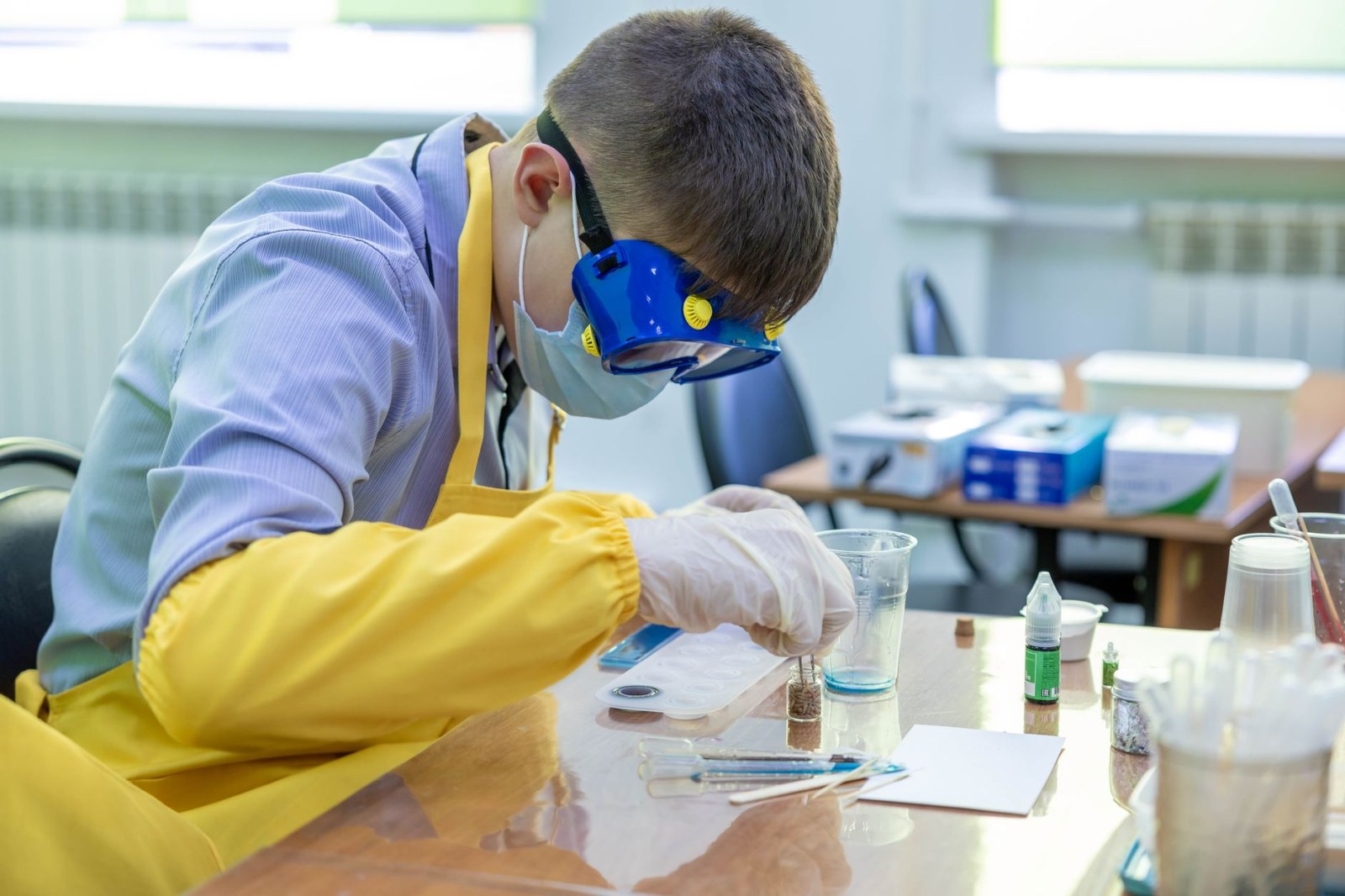
Young student in protective gear performing a chemistry experiment in a laboratory setting. · Photo by Sergei Starostin on Pexels · Original source · Pexels License · Resized and re-encoded as JPEG; full framing preserved.