





Key ideas
- Separating observations from explanations helps turn a broad concern into an answerable question.
- Comparisons need a consistent location, observation time and set of recording categories.
- A classroom activity describes a local sample; it does not establish causes, pollution levels or educational outcomes.
Start with a nearby question that can be answered
A classroom environmental investigation can begin with a schoolyard, an entrance or an approved green space. The essential steps are to choose an observable question, prepare a record and distinguish data from assumptions. This proposal is intended, as a practical suggestion, for learners aged 10 to 14. Teachers should adjust reading demands, support and independence to their group; the suggested age range is not an official curriculum alignment.
The aim is to practise observing, classifying, comparing and communicating uncertainty. The EPA provides resources, lesson plans and project ideas for students and educators. Its collection can extend the work, but the activities below are an original proposal. They do not reproduce an agency programme or promise demonstrated learning outcomes.
An answerable question might be: “What kinds of visible litter do we find in the same part of the schoolyard on different visits?” Asking “Why do people pollute?” requires information about behaviour and causes that this record cannot supply. Write down what the group can observe and what will remain outside the investigation before collecting anything.
Make observation safe and accessible
Paper, pencils, a writing surface and a clock are enough. The teacher chooses an area visible from a safe position, away from traffic, water and restricted spaces. Participants look and record: they do not collect litter, open containers, touch sharp objects or handle unknown substances. Looking at water or soil cannot establish that it is safe.
Observation, recording and timekeeping roles can be shared. Participation may also take place from a classroom, window or accessible route. Photographs of people are unnecessary. If images document the location, follow school rules and avoid identifying details. Supporting materials should have adequate contrast and a text alternative where needed.
Before going outside, agree on categories such as paper or cardboard, recognisable packaging and other objects. Record items that cannot be identified as “undetermined”; do not guess their composition. Agree how to avoid counting the same object repeatedly and exactly where the observation area starts and ends. These choices make the resulting record easier to interpret.
A litter activity: count without turning a sample into a diagnosis
Arrange 3 short visits, each with 5 minutes of observation, if school conditions permit. These are suggested organisational timings, not a validated research protocol. Keep the area and categories the same. Record conditions that changed, including recent cleaning, rain or an altered route. Such notes are part of the data, rather than details to remove because they complicate the comparison.
The table is a blank worksheet for real observations. Dashes do not mean zero: they mean no value has yet been entered. Use zero only after an observation in which no object in that category was seen.
| Place and date | Observation time | Category | Number seen | Uncertainty or conditions |
|---|---|---|---|---|
| To complete | To complete | To complete | — | To complete |
Compare categories within a visit, then the same category across visits. If the observation time or area changed, explain that the counts are not directly equivalent. A larger count can raise a new question, but does not identify who left the objects or establish the amount of waste produced by the whole school. Nor does it show that an intervention worked without an appropriate comparison.
A second activity: describe change before explaining it
Alternatively, observe a feature from the same position: fallen leaves, visible shade or the presence of birds. Record the date, location and a concrete description. Bird observations do not require naming a species to record what was seen; retain uncertain identifications. Do not disturb animals or approach nests.
The NEEF directory of environmental education activities lists eBird resources concerned with observing birds and exploring data. These offer a route to more specific materials. Their inclusion does not make every classroom count a biodiversity study or a basis for estimating populations.
Ask learners to separate 3 headings: “what I observed”, “the explanation I suggest” and “what information I need to check it”. Leaves on the ground are an observation; attributing them to wind requires further information. A single visit also cannot demonstrate a seasonal or climate trend. Keep those distinctions visible when discussing a graph or a shared display.
Interpret the record and choose a next step
The class can prepare the record and discuss results in 2 classroom sessions, adapted to the group's available time. Each team presents a conclusion bounded by its data, an uncertainty and a new question. Teachers may assess the clarity of the record and whether the conclusion follows from the observations, without presenting that assessment as a validated measure of environmental awareness.
NEEF describes opportunities to apply inquiry practices to community environmental issues. Its discussion of United States standards provides context, not automatic equivalence with other curricula. UNESCO's guidance on education for climate action organises expected learning outcomes by age and can help teachers consider progression and scope.
Finish with a proportionate action: improve an information sign, ask the person responsible for the space a question or repeat the observation using a clearer record. Informed participation includes recognising what remains unknown. A concrete question and responsible follow-up do not require a promise of a quantified environmental benefit.
What we know and its limits
An original teaching proposal, suggested for ages 10 to 14 and to be adapted by the teacher. It has not been classroom-validated and is not official EPA, NEEF or UNESCO material. Local observations do not establish causes, diagnose contamination, measure climate impacts or independently demonstrate changes in behaviour. School rules, accessibility and safe conditions take precedence.
Original sources4
The original sources for exploring this explanation and its limits.
-
EPA: Environmental Resources for Students and Teachers
United States Environmental Protection Agency
Institutional reference consulted to compare the educational offerings and approach of its own publisher. It does not substantiate empirical outcomes for the proposed activity. -
NEEF: Environmental Education Activities
National Environmental Education Foundation
Institutional reference consulted to compare the educational offerings and approach of its own publisher. It does not substantiate empirical outcomes for the proposed activity. -
NEEF: Environmental Education and Research Practices
National Environmental Education Foundation
Institutional reference consulted to compare the educational offerings and approach of its own publisher. It does not substantiate empirical outcomes for the proposed activity. -
UNESCO: Education for Climate Action
UNESCO
Institutional reference consulted to compare the educational offerings and approach of its own publisher. It does not substantiate empirical outcomes for the proposed activity.
Image credits
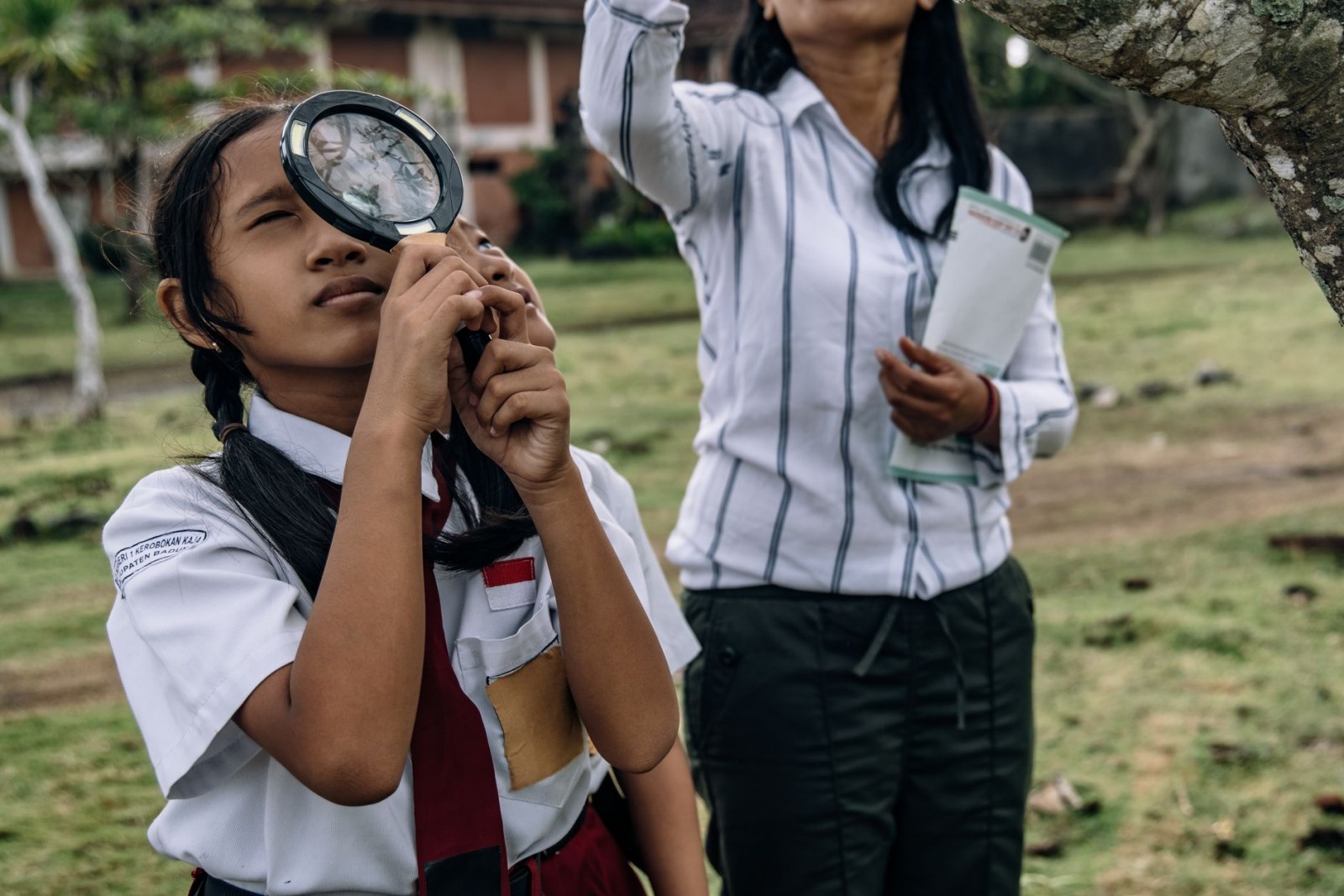
Students in school uniforms using a magnifying glass for outdoor exploration. Educational outdoor activity. · Photo by ROMAN ODINTSOV on Pexels · Original source · Pexels License · Resized and re-encoded as JPEG; full framing preserved.