





Key ideas
- Analytical calculations and simulations by a team from MIT and other institutions suggest that a primordial black hole with a mass similar to that of an asteroid could be captured by a star through a three-body interaction.
- The model predicts that, if the star rotates fast enough, a disk could form around the black hole and launch jets that would make it explode; the resulting flash could be detectable.
- MIT cautions that other phenomena can produce similar signals: a detection would require additional evidence and would not, by itself, confirm the existence of primordial black holes.
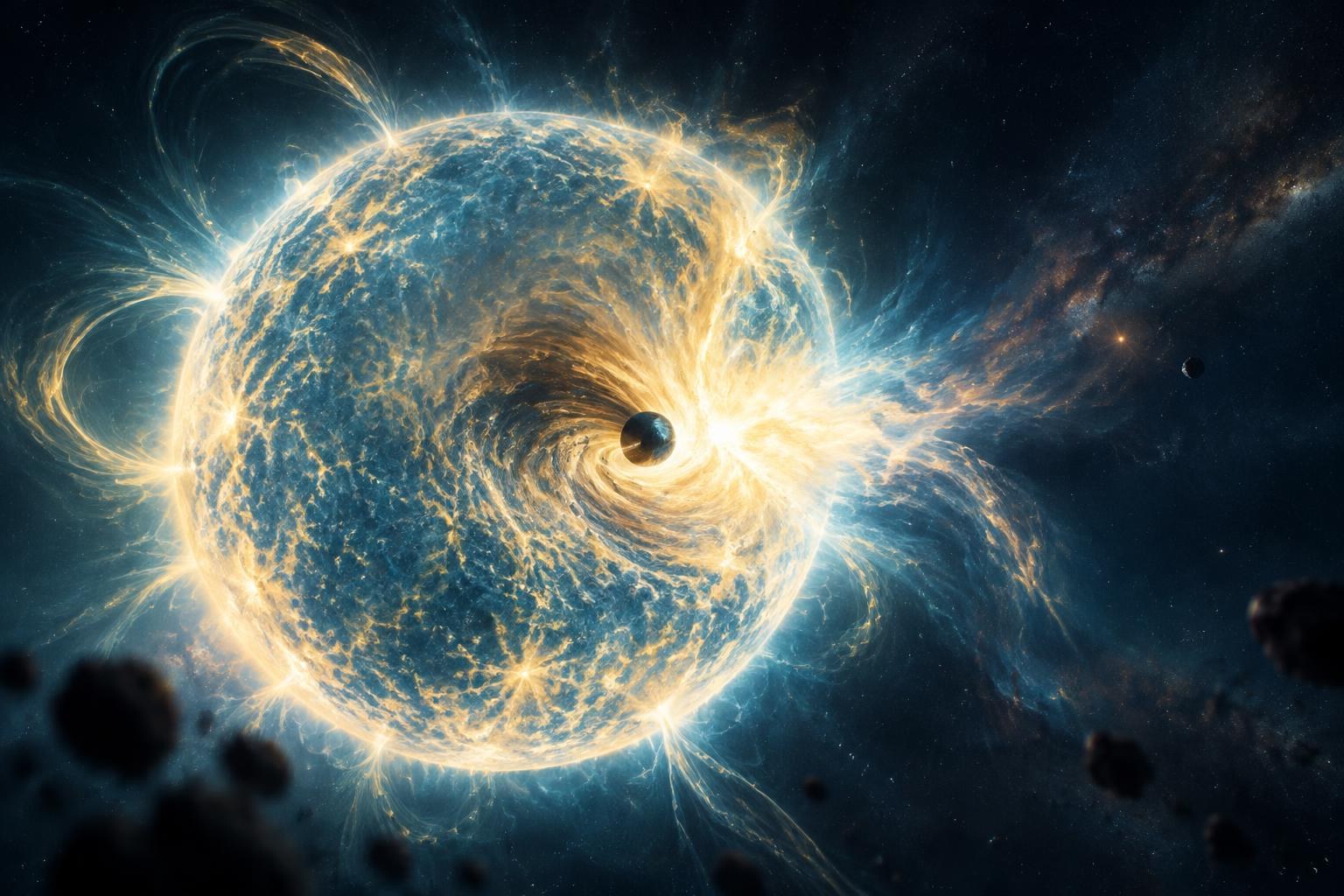
A team of physicists from MIT and other institutions calculated how a primordial black hole with a mass comparable to that of an asteroid might behave if it ended up inside a Sun-like star. Their analytical calculations and three-dimensional simulations describe a possible sequence: capture, fall toward the core, growth, and, if the star rotates fast enough, formation of a disk that could launch jets of matter and make it explode. According to MIT, the study was published in The Astrophysical Journal.
The proposal is a potential method for searching for these objects, not a discovery of primordial black holes. MIT notes that an explosion of this kind could produce blue and ultraviolet light, as well as gamma rays and X-rays; but other astrophysical phenomena can generate similar flashes. Therefore, even if one were detected, additional evidence would be needed to identify its cause.
From a possible capture to a fall toward the core
Primordial black holes are hypothetical: they may have formed in small, dense regions of the universe shortly after the Big Bang. MIT's account proposes that the smallest and lightest ones would already have evaporated through Hawking radiation, while more massive ones could persist. In the scenario studied, the object would be approximately the size of an atom and have a mass comparable to that of an asteroid, or about one-millionth of Earth's mass.
The team combined equations from general relativity, hydrodynamics, stellar evolution, and particle physics. Their results indicate that the gravity of an isolated star would not be enough to trap a black hole passing nearby. Instead, gravitational interaction with a companion—for example, another star or a planet—could favor capture. In this three-body configuration, repeated passages of the black hole through stellar material would gradually reduce its orbit. The process could take thousands to millions of years before the object reached the star's center.
This part of the scenario describes a calculated evolution, not an observation of an actual capture. The energy that the black hole returns to the surrounding gas also matters: according to the model, most of the energy would be transported into the black hole itself, allowing it to grow faster than previously thought. After several million years, it would have consumed about 1% of the star's mass.
The role of rotation and the disk
The explosive stage depends on one condition: the star must rotate fast enough. In that case, the gas would no longer fall directly toward the black hole, but could accumulate in a rotating disk around a black hole a few meters in size, located at the center of the star. MIT describes this disk as the step that would change the outcome: the magnetic field of the material, twisted by the black hole's rotation, would drive electromagnetic jets from its poles.
In the simulations, the jets would pass through the star and make it explode within tens of seconds after the disk formed. The full sequence, from possible capture to arrival at the core, unfolds over much longer timescales; the speed of the explosion should not be confused with the time required for the preceding process. MIT's report also states that the predicted emission would change over time: X-rays and gamma rays could appear first, followed by optical and infrared emissions and, later, radio emissions.
| Stage of the calculated scenario | Process described by MIT | Indicated timescale or condition |
|---|---|---|
| Capture | Gravitational interaction with a companion star or planet could trap the object; an isolated star would not be enough. | Three-body configuration |
| Fall to the center | Repeated passages through stellar material would reduce the orbit. | Thousands to millions of years |
| Growth | The black hole would consume gas and, after several million years, about 1% of the star's mass. | Depends on the energy transferred to the surroundings |
| Disk and explosion | If the star rotates fast enough, a disk would form and drive jets capable of passing through it. | Explosion within tens of seconds after the disk forms |
| Possible signal | High-energy emissions would be produced, followed later by optical, infrared, and radio emissions. | Detectability depends on distance and identifying the source |
A signal that would not be enough on its own
The researchers estimate that the flash could be bright enough for current telescopes, provided it did not occur too far away. However, detectability is not the same as conclusive identification. MIT explicitly cautions that other astrophysical processes could produce a similar signal and that the flash would need to be combined with other clues to attribute it to a primordial black hole.
One possibility mentioned by the team would be to assess whether the star's mass is consistent with an expected stellar explosion. If it were not, that could point to an internal process consuming it, although it would not by itself prove that a primordial black hole was responsible. In principle, the proposal could make it possible to search for these objects and set limits on their possible contribution to dark matter, but the account does not present detections or observational limits already obtained.
The NSF institutional information provided as context explains that the agency funds scientific research and that its investments include basic science projects.NSF: support for research This description provides context about one of the entities that supported the work, but it does not independently confirm the simulations or their conclusions. The other NSF reference concerns materials research programs and provides no direct evidence about primordial black holes or the stellar model described.
For now, the central result is a theoretical prediction about how the interaction between a primordial black hole and a star might manifest. The proposed search will depend on finding compatible signals and ruling out alternative explanations; the existence of these objects and their possible role in dark matter remain unconfirmed by the evidence described.
What we know and its limits
The scenario comes from calculations and simulations, not an observational detection. The explosion described depends on conditions such as capture of the black hole and sufficiently rapid rotation of the star. The predicted signal would not be unique to this mechanism, so identifying it would require additional evidence. The NSF context sources describe general support for research and materials programs; they do not independently corroborate these results.
Original sources3
The original sources for exploring this explanation and its limits.
- Studies and Results: How NSF Supports Research NSF
-
How research into materials is organized and what it produces
NSF
Institutional reference for context. It does not constitute independent confirmation of the main source's findings. - If tiny “primordial” black holes exist, here’s how we might find them MIT
Image credits
Editorial illustration by SciClue