





Key ideas
- As STEM Learning recommends, agree in advance with the teacher on the objectives, audience, participation, and details of the visit.
- Adapt the language and offer different ways to participate, without treating the stage-based examples as a validated scale.
- Plan safety with the school and distinguish what was observed from its explanation and what cannot yet be concluded.
Agree on the visit before entering the classroom
A science visit begins with a conversation between the guest and the teacher. It is helpful to agree on a question the group can explore and what students are expected to do or understand. The visitor contributes their expertise and explains the materials and their risks; the teacher knows the group, its needs, and the curriculum context, and remains involved throughout the activity. The guest’s professional experience does not replace the teacher’s knowledge of their students.
STEM Learning’s guide for teachers recommends maintaining good communication and sharing clear details of the activity in advance. As a complement, NISE Network’s guide to preparing a presentation by a guest scientist suggests discussing the audience, objectives, participation expectations, content, and duration; it also suggests sharing materials before the visit and checking the room and audiovisual equipment. These are professional guidelines, not evidence that each recommendation on its own produces a learning outcome.
| Aspect | Practical agreement before the visit |
|---|---|
| Objective | Define the central question and what students will be able to observe, explain, or ask. |
| Audience and participation | Share information about ages and prior knowledge, and discuss how the group will participate. |
| Content and duration | Agree on what will be covered and how much time will be available. |
| Preparation | Share notes or slides and check the room and audiovisual equipment in advance. |
| Safety | Consult the school’s procedures and agree on how the risks of each activity will be reduced. |
The table brings together topics raised in NISE’s guidance and the ACS safety recommendations; it is a planning aid, not a legal protocol or a guarantee that the visit will be suitable in every school.
Explain one central idea and open up different ways to participate
The scientist can start by choosing one central idea, defining essential terms, and avoiding unnecessary acronyms. NISE’s guide for STEM professionals speaking to non-specialist audiences recommends plain language, examples, images, models, and questions that invite people to observe or predict. An everyday example or analogy can help provide direction, but it is worth clarifying where it stops being useful: a comparison does not prove that two phenomena are identical.
The teacher can introduce vocabulary in advance and gather questions from the group. Reviewing the materials with the visitor makes it possible to connect the activity to what has been covered in class and discuss potential barriers to access. The universal design guide from Boston’s Museum of Science and NISE Network proposes considering physical and sensory access, easy-to-handle materials, and more than one way to engage. It also advises thinking through alternatives before the activity and, when possible, involving people with disabilities in its preparation.
At every age, students can respond by speaking, writing, drawing, or pointing. No one has to speak in public or handle materials to participate. The NISE Network and Sciencenter guide to talking and exploring with young children recommends allowing time and accepting nonverbal responses; it does not claim that a single presentation produces conceptual mastery.
The following questions are original and flexible examples, not a validated developmental scale or universal equivalences between age and ability:
| Suggested stage | Possible question | Possible response | Adult support |
|---|---|---|---|
| Preschool | “What changes when I put this object in front of the light?” | Point, move a figure, look, or make a drawing. | Demonstrate and explore without requiring a verbal explanation. |
| Primary school | “What do you notice? What stays the same and what changes?” | Compare two observations orally or with a drawing. | Allow time to observe and offer words for describing, without giving away a conclusion. |
| Secondary school | “Which variable have we changed, and what can’t we conclude yet?” | Suggest an explanation and mention a condition or limitation. | Facilitate discussion about variables and limitations, without presenting an activity as a complete test. |
These suggestions for primary and secondary school have not been validated by the early childhood guide. They are examples to adapt to the group, not rules about what students of a particular age can understand. Different forms of participation should also not become a way of classifying students into fixed learning styles.
Distinguish what was observed from what is interpreted
Help the group separate the question, the prediction, the observation, and the interpretation. A prediction anticipates what is expected to be seen; an observation describes what happened under specific conditions; an interpretation proposes how to explain it. UC Berkeley’s materials on observations, hypotheses, and theories provide context for distinguishing what was observed from what was inferred, without imposing a single method on all sciences.
The visitor can say: “This is what we observed,” “Our explanation is…” and “We can’t conclude… from this test.” This makes clear which part is based on the result and which is an explanation. It also creates space to ask what might be changed or explored next. A result from one activity does not by itself prove an entire theory.
If the scientist does not know an answer, they can acknowledge that and suggest looking it up through a channel agreed on with the teacher. Not knowing how to answer in the moment does not prove that the discipline has no answer. At the same time, scientific knowledge is not infallible: well-supported ideas may be revised if the evidence warrants it. That does not mean all opinions have the same level of support. UC Berkeley offers additional context on how scientific knowledge changes.
Plan for safety and safeguarding
Before a demonstration, consult the school’s procedures and the people responsible. The American Chemical Society (ACS) recommendations for outreach activities point out that school spaces do not necessarily have the ventilation and protective equipment of a laboratory. The ACS recommends selecting low-risk activities—which does not mean zero risk—discussing them with the host school, and documenting how risks will be reduced for each activity, including emergency plans.
The ACS guide to chemical demonstrations is intended for professionals with appropriate training and experience in chemistry and chemical safety. Being a scientist in another field is not enough. If the necessary competence, conditions, or an adequate assessment are lacking, it is preferable to choose a video, a model, or a discussion. Materials used in demonstrations must not be ingested. This guide does not propose recipes involving fire, lasers, hazardous substances, or pressurized systems.
Safeguarding minors also requires agreeing on professional boundaries and following the school’s procedures. As a cautious approach, route communication through the institution and do not arrange private contact or take photos or recordings without authorization. If a concern arises, report it to the school’s designated safeguarding lead; do not investigate on your own or promise absolute secrecy. The IChemE and STEM Learning guides are situated in the UK context: the DBS/PVG checks mentioned by STEM Learning are not universal legal requirements. General guidance does not certify an activity as safe or replace the school’s rules or local legal advice.
A short activity: observing a shadow
This proposal adapts the principle of blocking light; it is not the RGB setup with red, green, and blue lights in Exploratorium’s resource on colored shadows, and one flashlight is not expected to produce colored shadows. An adult prepares and tests a battery-powered LED flashlight, a large opaque silhouette, and a light-colored screen, in accordance with the local assessment.
- Predict: Ask where they expect to see the shadow when the silhouette is placed between the light and the screen.
- Observe: The adult operates the flashlight and shows the silhouette; the group can describe, draw, or point to what they see.
- Change one condition: Change one position and compare it with the previous situation, without claiming in advance what the measured results will be.
- Distinguish: Separately record what was observed, what explanation is proposed, and what question remains open.
Do not shine the light into people’s eyes, and keep pathways illuminated. Offer an alternative using images, verbal description, or a model, so participation does not depend solely on sight. The activity makes it possible to explore a relationship between light, an object, and a shadow under specific conditions; it does not prove a universal rule or explain all of optics. The group should describe what it observes in its own setup.
Return to the question after the visit
The teacher can revisit the question in another class. An exit ticket can ask for an observation, a drawing, an explanation, or a new question; the visitor can provide an indicative response through the school’s channel. A qualitative rubric can focus on whether the student describes evidence, distinguishes an explanation from a limitation, and asks a relevant question.
Satisfaction is not the same as understanding: a single visit does not make it possible to attribute improved learning or promise that it will inspire students to pursue science. The institutional resources serve different purposes: STEM Learning provides guidance on coordination; NISE Network offers guidance on planning and communication; the guide from Boston’s Museum of Science and NISE Network addresses accessibility; the ACS provides safety and training resources; UC Berkeley offers materials on evidence; and Exploratorium offers an optics activity. The ACS outreach training program includes planning, communication, follow-up, and safety. The on-demand course is available without requiring membership, with free access through registration in the ACS Learning Center and an ACS ID; completing it does not automatically qualify someone to conduct any demonstration or replace school approval or the specific training required.
What we know and its limits
The recommendations come from institutional guides and an educational optics resource, not from trials measuring the effectiveness of this proposal. The examples by stage, the shadow sequence, and the follow-up suggestions are flexible proposals, not validated developmental scales or guarantees of learning. Safety, accessibility, and safeguarding conditions must be checked with the school and adapted to local rules; this guide does not certify activities or provide legal advice. The shadow sequence illustrates a relationship under specific conditions and does not represent all of optics.
Original sources12
The original sources for exploring this explanation and its limits.
-
STEM Ambassadors: A Guide for Teachers
STEM Learning
Guide to the UK program for coordinating activities with STEM specialists. -
Safeguarding Children During School Visits
Institution of Chemical Engineers (IChemE)
Guide for volunteers in educational settings: professional boundaries and communicating concerns. -
Preparing a Presentation by a Guest Scientist
NISE Network
Recommendations for agreeing on the audience, objectives, participation, and logistics. -
Guidance for Scientists Speaking to a Non-Specialist Audience
NISE Network
Clear language, everyday analogies, questions, and acknowledging what is not known. -
Talk and Explore with Young Children
NISE Network / Sciencenter
Guidance for science experiences with young children and nonverbal responses. -
Universal Design for Science Education Programs
Museum of Science, Boston / NISE Network
Guide to offering different ways to access and participate physically and sensorily. -
Safety in Science Outreach Activities
American Chemical Society
Selection of lower-risk activities and planning with the host institution. -
Safety Guide for Chemical Demonstrations
ACS Division of Chemical Education
Rehearsed procedures, training, and precautions for demonstrations. -
Scientific Observations, Hypotheses, and Theories
UC Museum of Paleontology, University of California, Berkeley
Differences between what is observed, the explanation, and the predictions. -
How Scientific Knowledge Changes with Evidence
UC Museum of Paleontology, University of California, Berkeley
Review of well-supported explanations and the difference between uncertainty and total ignorance. -
Colored Shadows: Light, Objects, and Observation
Exploratorium Teacher Institute
An optics activity with questions and an explanation of shadows and additive color mixing. -
Training to Prepare and Evaluate Science Outreach Activities
American Chemical Society
A course for training volunteers in planning, communication, and safety.
Image credits
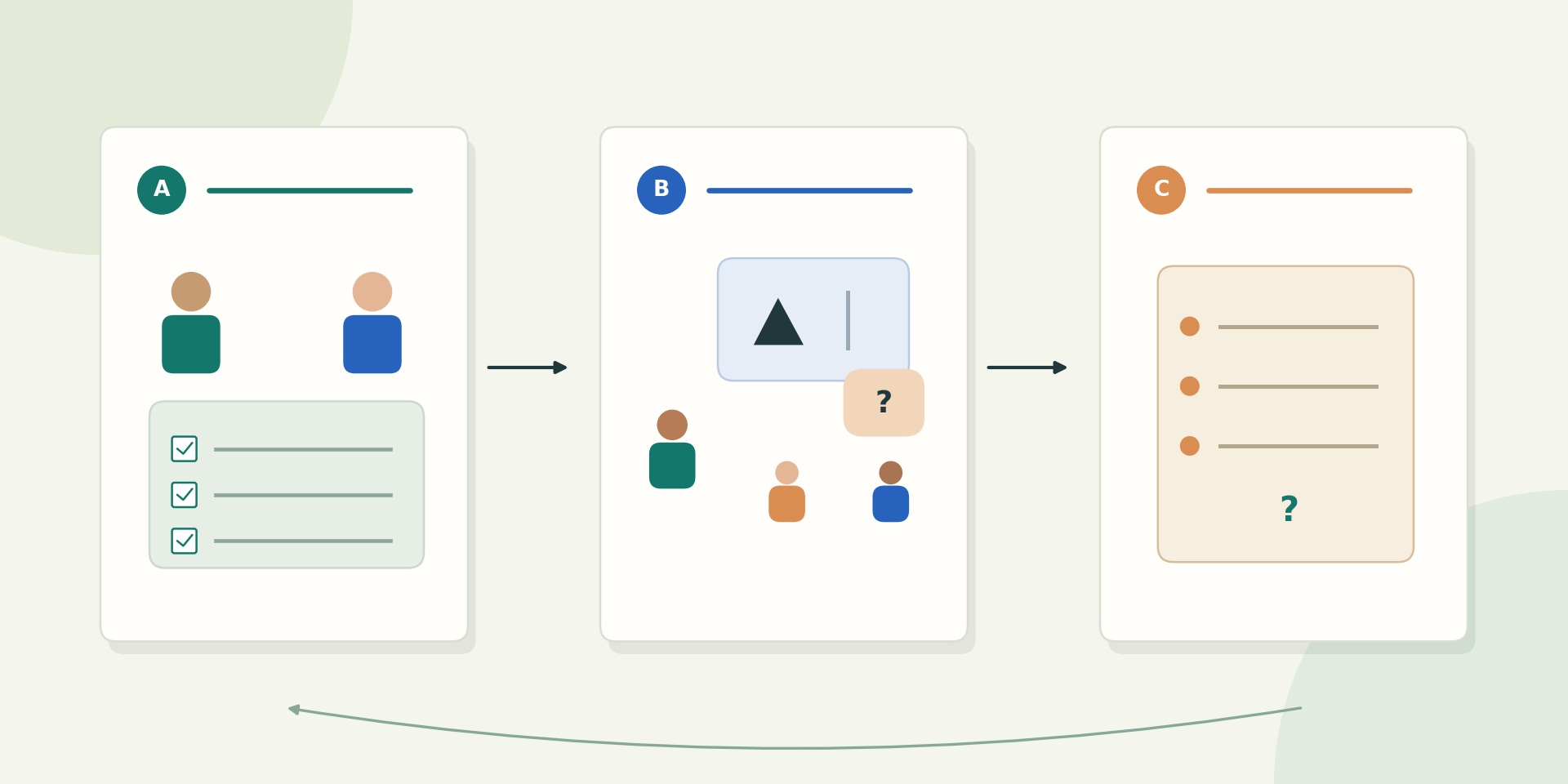
Editorial Team · original educational illustration · Original source · Recurso editorial propio · derechos reservados · Conceptual illustration of shared preparation, classroom participation, and follow-up. Symbolic figures, not a representation of experimental results.