





Key ideas
- An object with mass cannot reach the speed of light through local acceleration. A geometric shortcut requires additional assumptions.
- Rotation can produce apparent weight. Quantum teleportation transmits a state and requires classical communication.
- When changing scale, both weight and the area bearing the load, as well as the time over which the force is applied, matter.
The Millennium Falcon needs its hyperdrive to work in order to escape. In another story, a ship offers its crew something much more everyday: a floor to walk on. The two scenes raise questions that physics can answer with very different degrees of certainty. To distinguish between them, it helps to ask what would have to happen off screen.
Hyperspace and the speed-of-light limit
In fiction. In The Empire Strikes Back, the Millennium Falcon's hyperdrive fails during the escape from Hoth. The malfunction matters because hyperspace is the escape route offered by the story.
In physics. Special relativity sets the speed of light in a vacuum, c, as the local limit for transmitting signals. As a ship with mass accelerates, each increase in speed takes more energy as it approaches c. Reaching it would require unlimited energy. Time dilation allows less time to pass aboard than for those who stay behind, but the ship still travels below that limit.
Verdict. Exceeding c through local acceleration contradicts relativity. The saga's hyperspace is a narrative license. There is a different mathematical idea: Alcubierre's geometry makes it possible to describe a globally faster journey without the ship exceeding c in its immediate surroundings. Its original formulation requires negative energy densities for certain observers. It is a speculative hypothesis, with no demonstrated physical mechanism for building it.
Mass and energy in a container
In fiction. In Angels & Demons, a container holding antimatter stolen from CERN embodies the story's threat. The scene takes for granted that the problem of storing and transporting enough to produce the effect shown has been solved.
In physics. E₀ = mc² relates the mass of a system to its rest energy. When particles of matter and antimatter annihilate, the initial energy reappears in the reaction products. In the ideal case of a particle and its antiparticle initially at rest, the mass of both must be counted. Total energy and momentum are conserved. The large value of c² explains why a small mass can correspond to a great deal of energy. Producing antimatter, confining it, and harnessing the energy of the products are separate problems. With current techniques, much more energy is spent producing antimatter than would be recovered by annihilating it.
Verdict. Annihilation and mass-energy equivalence are established physics. The availability and storage assumed by the scene are narrative liberties.
A spinning floor
In fiction. In 2001: A Space Odyssey, the crew can walk inside a rotating section of the ship. The floor moves with the rotation.
In physics. The floor pushes the feet toward the axis and forces the body to follow a circular path. This support force is felt as weight. The acceleration has magnitude a = ω²r, where ω is the angular velocity and r is the distance from the axis. For the same acceleration at floor level, a larger radius allows the structure to spin more slowly. In a small habitat, the head and feet can experience appreciably different accelerations. When walking or moving the head, Coriolis effects are also noticeable and alter how motion is perceived.
Verdict. Physics allows apparent gravity through rotation. What remains speculative is how a habitable habitat would be designed and operated during a long mission. The radius, rotation rate, and crew tolerance all matter.
What actually gets teleported
In fiction. In Star Trek: Strange New Worlds, Una activates the transporter and Kirk appears aboard. The story uses the device to move a person between two places.
In physics. Quantum teleportation transfers a quantum state to an existing receiving system. The protocol uses shared entanglement, a measurement at the source, and a classical message that allows the receiver to complete the operation. In the end, there are not two copies of the initial state. Nor does the original system's matter travel. Until the message arrives, the receiver cannot recover the state at will.
Verdict. Moving a person as in the series is a narrative license. If the device transmits usable information instantaneously over a distance, that aspect does violate relativity's causal limit.
Superman, the airplane, and scale
In fiction. In Superman Returns, Superman tries to stop a falling airplane. The physics question begins when he touches the fuselage. How does the force pass from the point of contact to the rest of the aircraft?
In physics. To brake, the airplane's momentum must change. The shorter the maneuver for the same change in momentum, the greater the average force. Even if Superman could exert it, the structure would have to transmit it without breaking. For a perpendicular load distributed uniformly, the average stress is force divided by area. Applying the same force over a small area increases that stress. A real fuselage adds complications such as bending, stress concentrations, and the distribution of loads among its parts.
The same idea explains why making a character gigantic changes the problem. If their height is doubled while shape and density are preserved, volume and weight increase eightfold, while the area of a similar cross-section increases fourfold. Under those assumptions, the stress due to their own weight doubles. Supporting themselves would require changes in proportions, material, or how the load is distributed.
Verdict. Stopping and supporting an airplane is compatible with mechanics if the load and deceleration are tolerable. The license lies in taking for granted that the hero's force alone is enough and that the fuselage and passengers can withstand any maneuver.
Five scenes, five checks
| Scene | What to check | Physical verdict |
|---|---|---|
| Jump to hyperspace | Local speed and the geometry of the journey | Narrative license. Local acceleration above c is prohibited. |
| Antimatter in a container | Total energy and confinement | Annihilation is real. The story's storage is a license. |
| Spinning ship | Radius, rotation, and the force from the floor | Allowed by physics. Habitat design remains an open question. |
| Transporter | What is transferred and when the classical signal arrives | Human transport is fiction. An instantaneous signal would violate relativity. |
| Airplane rescue | Braking time and load distribution | The maneuver depends on structural strength and deceleration. |
The next time a scene seems impossible, try identifying what it needs to explain: a speed, an energy balance, a force, or a signal. Each question leads to a different law. You can continue exploring them in the Physics section.
What we know and its limits
The verdicts refer to the physical interpretations described. The scenes do not specify all their mechanisms or allow real loads to be calculated. The scale comparison assumes similar shapes, equal density, the same material, and a load due to their own weight. Alcubierre geometry is a mathematical proposal with unresolved physical requirements.
Original sources12
The original sources for exploring this explanation and its limits.
- Millennium Falcon, official profile Lucasfilm
- Special relativity and the speed of light Instituto Max Planck de Física Gravitacional
- The warp drive: hyper-fast travel within general relativity Miguel Alcubierre
- Setting the record straight: antimatter in Angels & Demons CERN Courier
- E = mc², relativity notes MIT OpenCourseWare
- Antimatter, production and annihilation CERN
- Studies of artificial gravity and motor control NASA Task Book
- Evidence report on artificial gravity NASA
- Subspace Rhapsody, official recap Star Trek
- Quantum teleportation, protocol and resources IBM Quantum
- Superman Returns, aerial rescue sequence Movieclips / Warner Bros.
- Stress, strain, and elastic modulus OpenStax, Rice University
Image credits
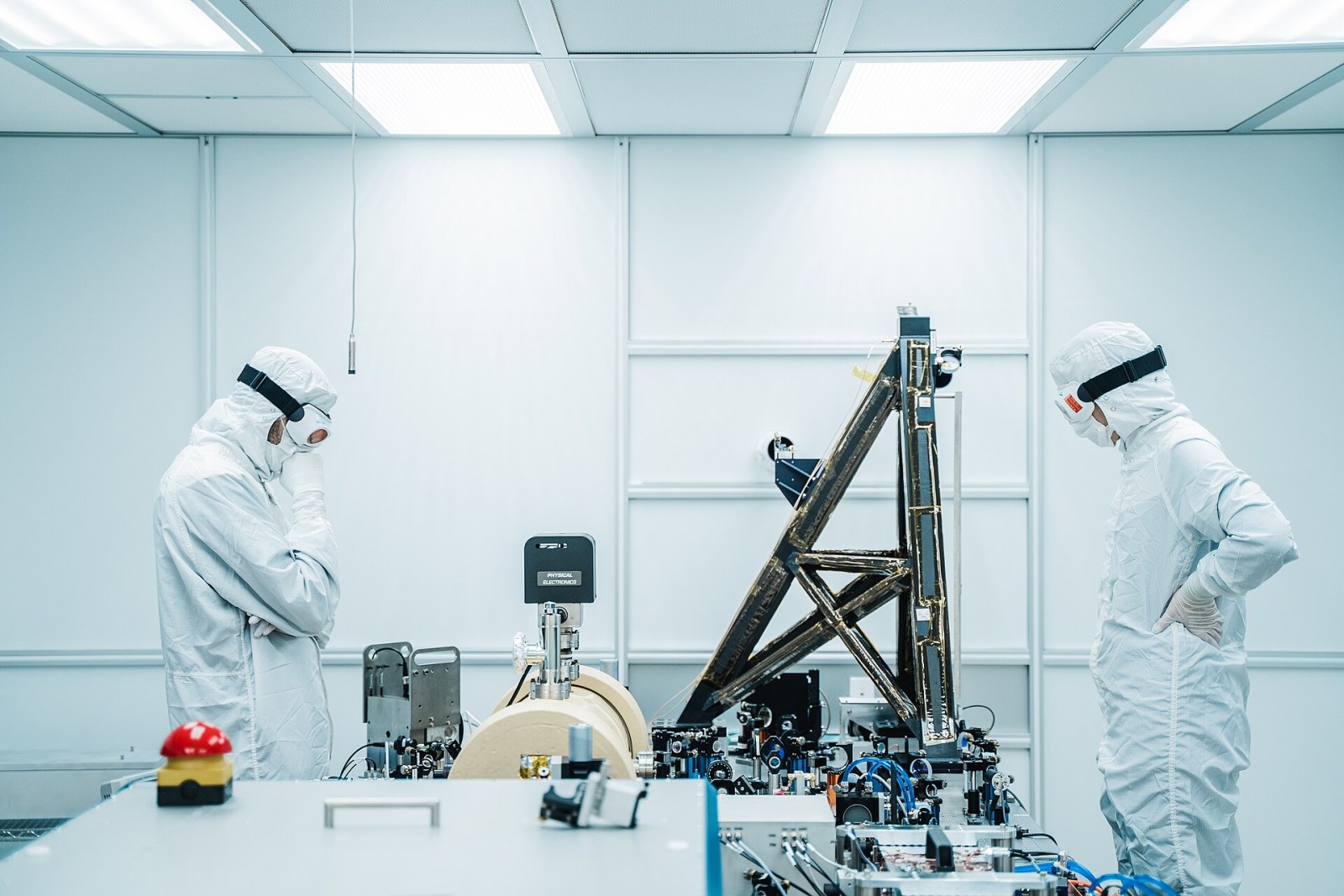
Baffled LIGO Scientists · Nkij · Wikimedia Commons · CC BY 4.0 · Original source · CC BY 4.0 · Resized and re-encoded as JPEG; full framing preserved.