





Key ideas
- NASA reports that Chandra observations link AT 2016blu’s periodic outbursts to the capture of material by a companion that could be a stellar-mass black hole or a neutron star.
- AT 2016blu had at least 27 optical outbursts between 2012 and 2026, approximately every 113 days; in March 2026 it was at least 100 times brighter in X-rays than in data from 2001–2002.
- The system is a candidate ultraluminous X-ray source and could offer clues about variable massive stars, although the companion has not been identified and it has not been established that all these phenomena share a mechanism.
A star that brightens repeatedly
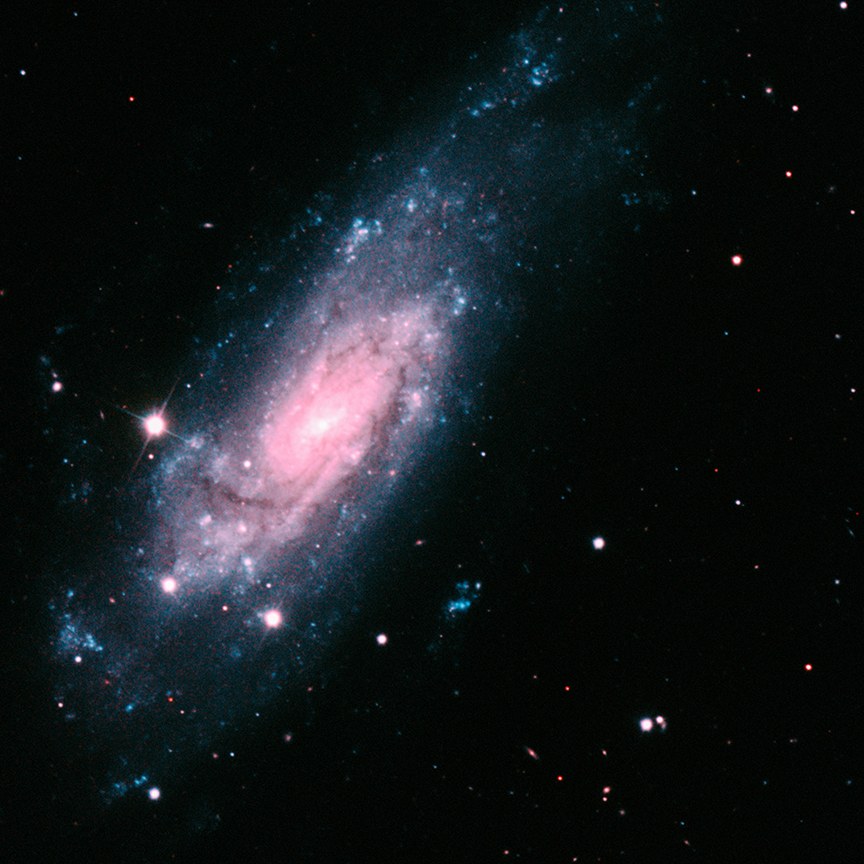
The star AT 2016blu, located in the spiral galaxy NGC 4559, shows periodic increases in brightness that puzzled astronomers for years. According to NASA, observations from the Chandra X-ray Observatory suggest that the outbursts are related to a previously hidden companion object, which attracts material from the star as the two orbit each other. The companion could be a stellar-mass black hole or a neutron star; the data described do not allow a choice between these possibilities.
AT 2016blu is a luminous blue variable: a hot, massive star whose brightness changes. It belongs to a type that undergoes rapid, repeated increases in brightness, so intense that they can look like supernova explosions. However, the star survives these episodes, which is why it is also described as a supernova impostor. NASA reports that its mass is estimated to be at least 33 times that of the Sun and that it is about 30 million light-years from Earth.
At least 27 visible-light outbursts were detected between 2012 and 2026, approximately every 113 days. The regularity and the star’s survival made it necessary to distinguish between a destructive explosion and a recurring process. The explanation proposed by the team links the cycle to the motion of a compact companion in an oval-shaped orbit.
The decisive clue came in X-rays
Visible light alone did not reveal what triggered the episodes. The team proposed that periodic X-ray flashes could heat the dense gas around the system, which would then glow at optical wavelengths. To test this idea, Chandra’s observations had to coincide with an optical outburst.
When monitoring indicated that AT 2016blu was undergoing an outburst in early 2026, Chandra observations were activated and obtained in March of that year through the Target of Opportunity program, designed to respond to special events. NASA notes that Chandra was the only X-ray telescope with sufficient resolution to distinguish AT 2016blu from another bright nearby source.
The March 2026 data showed that the star was at least 100 times brighter in X-rays than in Chandra data from 2001 and 2002, before the outbursts began. The interpretation that best fits this difference is that, as the companion approaches along its orbit, some of the material ejected by the star falls toward it. The captured material orbits at high speed and heats up enough to emit intensely in X-rays.
| Observation described by NASA | What it contributes to the explanation | Scope of the interpretation |
|---|---|---|
| At least 27 optical outbursts between 2012 and 2026, approximately every 113 days | Documents the recurrence of the phenomenon | Periodicity alone does not identify the cause |
| Chandra observations in March 2026 during an outburst | Show X-ray brightness at least 100 times higher than in 2001–2002 | The comparison supports a change associated with the episode |
| Material that would be captured during the orbital approach | Provides a possible mechanism for the X-ray emission and the outbursts | The companion remains one of two possibilities: a black hole or a neutron star |
Optical observatories helped identify when the outburst occurred: the team used the Katzman Automatic Imaging Telescope, the Las Cumbres Observatory Global Supernova Project, and observations from the American Association of Variable Star Observers, including those from more than 30 amateur astronomers. Coordination in time was important because, according to NASA, the X-ray observations had to be made during an optical episode.
What the finding does—and does not—mean
NASA presents the result as the first X-ray detection of a star of this class and the first object of this type found with a companion that is a black hole or a neutron star. AT 2016blu is also bright enough in X-rays to be considered a candidate ultraluminous X-ray source, a category of rare sources that is not yet fully understood.
The observations suggest a possible connection between these ultraluminous sources and the violent outbursts of stars like AT 2016blu. The proposal is relevant because many ultraluminous sources show large changes in X-ray brightness, but the announcement does not claim that they all share the same mechanism. Similarly, the system could help researchers study stars whose brightness changes before a supernova: astronomers suspect that some of this behavior may be due to systems containing a massive star and a compact object, or another massive star.
The report describes an explanation supported by the timing coincidence and the contrast in X-ray brightness, but leaves the companion’s exact nature unresolved. In addition, the NSF references included here explain how that institution supports scientific research and materials studies; they do not provide independent confirmation of AT 2016blu or the Chandra observations. NSF: research support · NSF: materials research
What we know and its limits
The interpretation is based on the observations described by NASA; the companion has not been conclusively identified and could be a stellar-mass black hole or a neutron star. The possible relationship with ultraluminous X-ray sources and with changes preceding supernovae is presented as a hypothesis, not as a general explanation. The NSF references provide context about institutional support and materials, not independent confirmation of this result.
Original sources3
The original sources for exploring this explanation and its limits.
- Studies and Results: How NSF Supports Research NSF
-
How research into materials is organized and what it produces
NSF
Institutional reference for context. It does not constitute independent confirmation of the main source's findings. - NASA’s Chandra Finds Source of Star’s Mysterious Outbursts NASA
Image credits
NASA's Chandra Finds Source of Star's Mysterious Outbursts (AT 2016blu Optical) · Sloan Digital Sky Survey (SDSS) · Original source · CC BY 4.0 · Resized and re-encoded as JPEG; full framing preserved.