





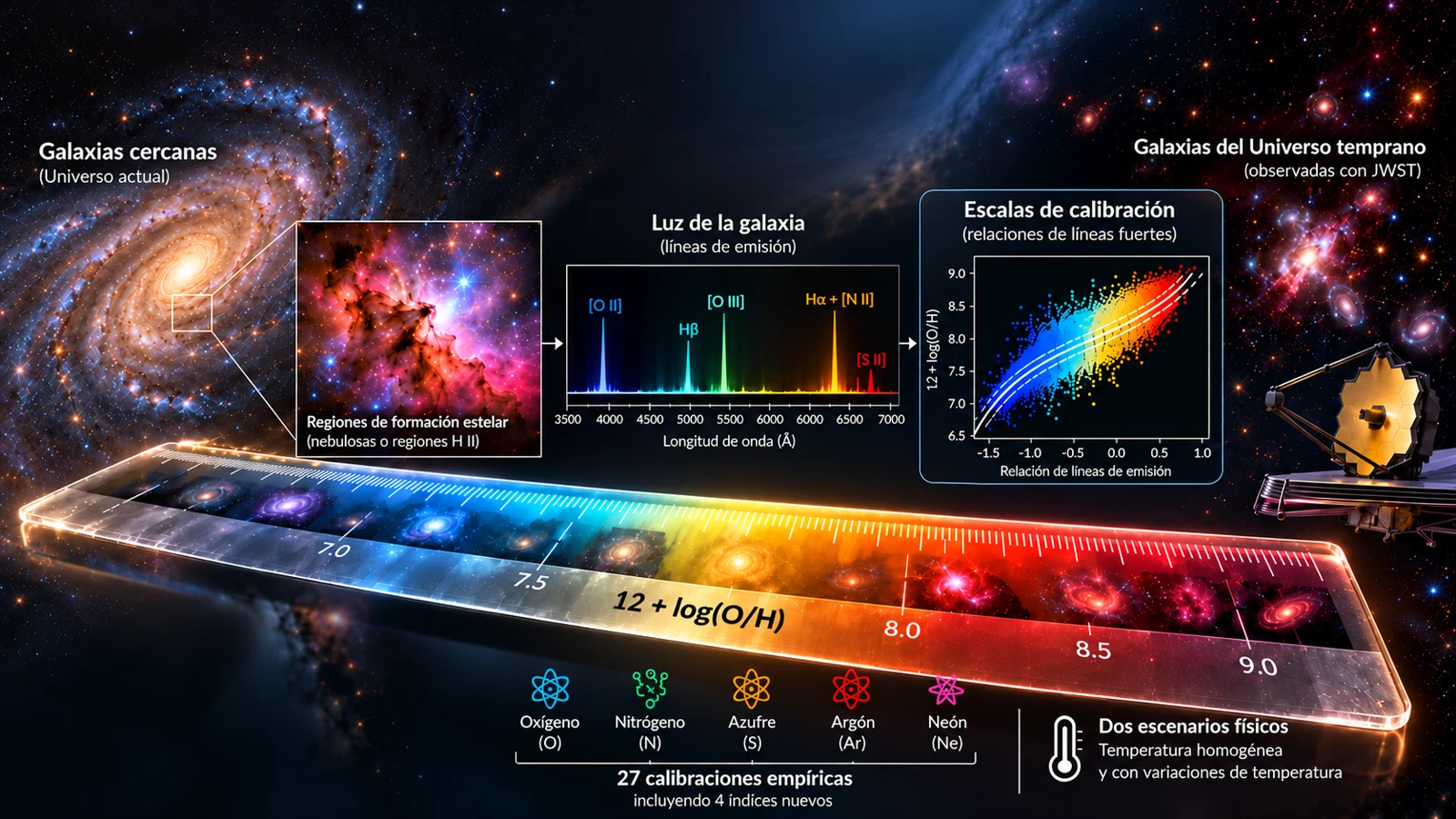
An international team, including researchers from the Instituto de Astrofísica de Canarias (IAC), has developed a new generation of calibrations that make it possible to estimate the chemical composition (metallicity) of both nearby galaxies and the most distant and earliest galaxies in the Universe observed by the James Webb Space Telescope. The study is based on the analysis of the largest collection of high-quality spectroscopic observations assembled to date, the result of more than a decade of work collecting and analyzing data.
Metallicity as a fossil record of galactic evolution
To understand the origin and evolution of galaxies, their chemical composition is studied through the spectrum of the ionized gas clouds they contain, known as HII regions. The emission from these nebulae comes from excitation caused by the ultraviolet light of massive stars newly formed within them. HII regions, like any other cosmic object, contain various chemical elements synthesized by earlier generations of stars and released into space at the end of their lives. For this reason, a galaxy’s metallicity constitutes a kind of fossil record of its evolution over time: the higher its metallicity, the more the gas has been processed by earlier generations of stars, making it possible to reconstruct the history of galaxy formation and evolution throughout cosmic history.
But determining the chemical composition of an HII region from its spectrum is not a straightforward process. It requires precise knowledge of the gas density and temperature, as well as the characteristics of the radiation it receives from the stars. Measuring these properties requires high-quality observations, with long exposure times on some of the world’s largest telescopes, which can even detect nebular emission from faint, distant galaxies.
27 calibrations based on the DESIRED database
The research team, led by Fabián F. Rosales-Ortega (INAOE, Mexico), used the DESIRED (DEep Spectra of Ionized REgions Database) database, a collection assembled over more than ten years that brings together high-quality optical spectroscopic observations of ionized nebulae, both in our Milky Way and in other galaxies in the Universe.
In total, the study used nearly 2.392 observations, an unprecedented amount of information for this type of analysis. “We can review the methods used to measure the chemical composition of galaxies on a much more solid basis than before,” says Rosales-Ortega, first author of the article.
Using this dataset and recalculating all the necessary parameters consistently, the researchers obtained new formulations for the 23 scales, or calibrations, that have historically been used to estimate the metallicity of galaxies when it is not possible to determine the gas temperature from its spectrum. Metallicity is expressed through oxygen abundance, that is, the ratio between the number of particles of this element and the number of hydrogen particles.
These calibrations are constructed from the intensity of the brightest spectral lines in HII regions, which is why they are called “strong-line methods”; they use different combinations of oxygen, nitrogen, sulfur, argon, and neon lines. In addition, the study incorporates four new methods that had not previously been calibrated empirically. In total, it provides formulations for 27 calibrations based on high-quality observations, expanding the range of physical conditions under which they can be applied and constituting one of the most complete and robust empirical references currently available for estimating the metallicity of galaxies.
“These calibrations are essential for distant galaxies, where weak lines are not detected, and using such a large, high-quality sample increases the reliability of the metallicities derived,” explains Jorge García-Rojas, an IAC researcher and co-author of the article.
The impact of temperature fluctuations
There is also a fundamental problem that has affected the determination of the chemical composition of nebulae for decades: temperature fluctuations inside them can introduce biases into the calculation of chemical abundances.
In this new work, strong-line method calibrations are formulated for the first time under two different physical scenarios: a traditional one, which assumes a uniform temperature in objects, and another that takes temperature fluctuations into account. When these are included, metallicities are, on average, around 35 % higher than those obtained using traditional methods. This result provides a quantitative measure of the effect that the gas’s thermal structure has on metallicity estimates.
“Including the effect of temperature fluctuations is new in this type of study, and now we can determine how the metallicity scale changes depending on the scenario adopted,” says César Esteban, senior lecturer at the University of La Laguna, an IAC researcher, and co-author of the article.
Application to the early Universe and publication
The research team also tested the proposed new scales against spectral data from the most distant known galaxies, formed just a few hundred million years after the Big Bang and revealed thanks to the James Webb Space Telescope (JWST). The analysis shows that many calibrations built using galaxies in the nearby Universe can also provide reliable estimates in the early Universe, at great cosmological distances. In some cases, the differences that arise can be explained by the greater intensity of the stars’ ultraviolet radiation fields and/or by a different proportion of nitrogen in these early galaxies.
Ultimately, this work makes it possible to use a common scale to study the chemical evolution of galaxies across a large part of cosmic history, from our spatial and temporal neighborhood to epochs when the Universe was only a fraction of its current age.
The following IAC researchers contributed to the study: César Esteban, Jorge García-Rojas, Maialen Orte-García, Elena Reyes-Rodríguez, and Sebastián F. Sánchez.
This work is the first article in a series devoted to developing new strong-line calibrations within the international DESIRED collaboration. The new calibrations are freely available to the entire astronomical community. The article has been published in the scientific journal Monthly Notices of the Royal Astronomical Society (MNRAS), one of the leading international publications in astronomy and astrophysics.
Article: F. F. Rosales-Ortega, J. E. Méndez-Delgado, J. U. Guerrero-González, C. Esteban, J. García-Rojas, K. Z. Arellano-Córdova, A. Z. Lugo-Aranda, O. Espíndola-Camacho, J. C. López-Gutiérrez, L. E. Martínez-Rivero, C. Morisset, M. Orte-García, E. Reyes-Rodríguez, L. Toribio San Cipriano, K. Kreckel, O. Egorov, I. A. Zinchenko, S. F. Sánchez, and J. M. Vílchez. “The DESIRED strong-line calibrations: I. New empirical metallicity relations for the local and high-redshift universe”, Monthly Notices of the Royal Astronomical Society, 2026. DOI:
Content from the press release of the Instituto de Astrofísica de Canarias, translated and adapted for this edition.
Instituto de Astrofísica de Canarias · 2026-11-10
DESIRED-I: scientific graphic provided by the IAC for its release on galaxy metallicity calibrations. © IAC · Press material
Original sources1
The original sources for exploring this explanation and its limits.
-
The IAC takes part in new scales for measuring the chemical composition of galaxies
Instituto de Astrofísica de Canarias
Press release 2026-11-10
Image credits
IAC · Press material · Original source · Material de prensa facilitado para uso editorial con atribución