





Key ideas
- Hazard describes properties capable of causing adverse effects; risk also takes exposure, dose, route, and circumstances into account.
- Assessment integrates experimental studies, epidemiology, and environmental data, weighing quality, relevance, biases, uncertainty, and variability.
- Scientific assessment informs risk management, but regulatory decisions also depend on the legal framework, protection goals, alternatives, and timelines.
Hazard, exposure, and risk: distinct concepts
That a substance has properties capable of causing adverse effects describes its hazard. By itself, it does not indicate the probability that harm will occur in a particular situation. Risk is characterized by considering that hazard together with exposure and the probability of harm. Therefore, a substance’s properties are not enough to estimate the risk of each use: it also matters who or what organism comes into contact with it, by what route, and under what conditions. The Swedish Chemicals Agency (KemI) explains these distinctions and notes that assessment compares specific toxicity with measured or estimated exposure to determine whether there is cause for concern and whether measures may be required. .
Exposure describes how and at what concentration a person or organism comes into contact with a substance. It can occur through ingestion, inhalation, or skin contact. The concentration in a medium, such as water or air, is not necessarily equivalent to the dose a person receives. The external dose is the amount that comes into contact with the organism; the absorbed or internal dose is the amount that crosses the entry barriers and becomes available within it. Therefore, the concentration in the medium alone does not reveal the internal dose. Exposure depends on local conditions, and frequency and duration also matter: brief exposure is not automatically comparable to repeated or prolonged exposure. Some stages of life may be more sensitive to certain effects.
Dose-response examines how the probability or magnitude of an effect changes as the dose varies. There is no universal threshold that applies to all substances and effects. The fact that a substance is detectable also does not prove that its presence caused harm: information about exposure, effects, and their connection is needed. Conversely, failing to detect a substance in one measurement is not enough to rule out exposure at other times or places.
How an assessment is constructed
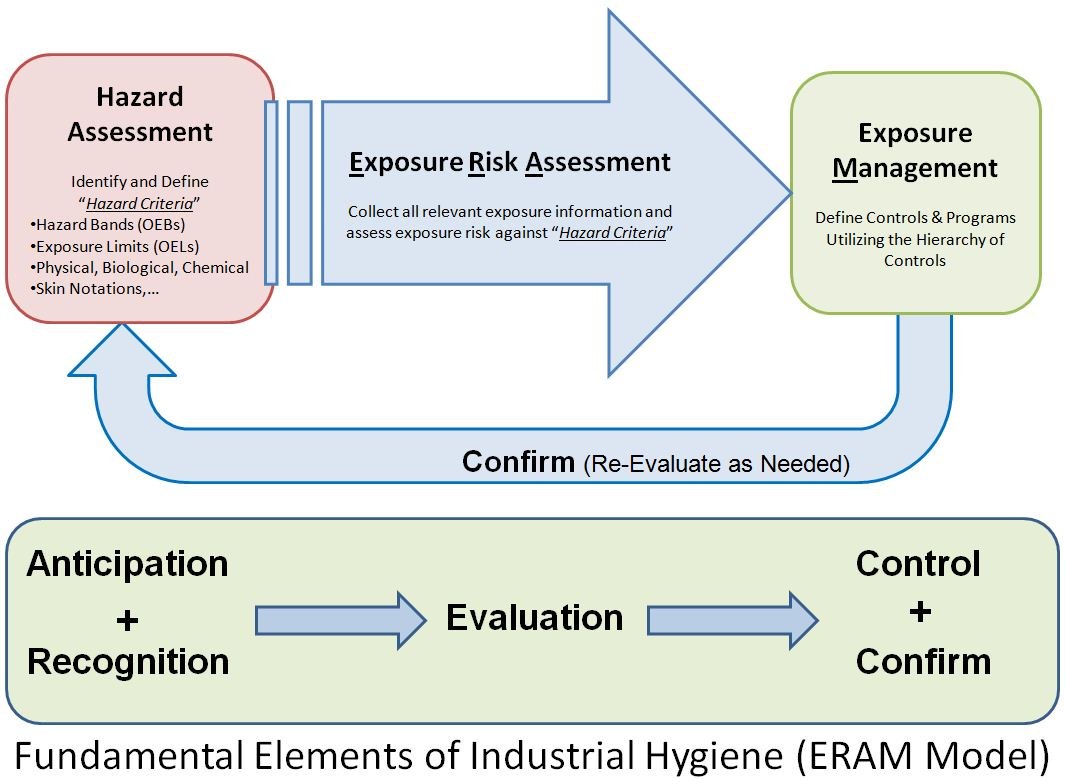
Assessment is usually organized into four related phases: hazard identification, characterization of the dose-response relationship, exposure assessment, and risk characterization. In the final phase, information about effects is compared with measured or estimated exposure. This is not a universal operation of multiplying two figures: the evidence, units, and assumptions must be relevant to the case. The World Health Organization presents a toolkit to help identify and obtain information about chemical hazards, exposures, and health risks in local or national contexts. .
Evidence may come from experimental toxicology, epidemiological studies in people, and environmental monitoring. Experiments make it possible to study effects under controlled conditions, but extrapolating results across species, doses, and circumstances requires caution. Epidemiology provides human data, although it may be affected by errors in estimating exposure, selection bias, or confounding factors. An association between exposure and an effect does not, by itself, demonstrate causation. Monitoring shows where and when substances were measured; a single environmental measurement does not establish that a substance caused a particular disease or ecological harm.
These lines of evidence are complementary, not interchangeable. Each study is assessed for its relevance to the question, validity, reliability, precision, consistency with other findings, and possible biases. Missing data and conflicting evidence also matter. Integration does not mean counting papers or deciding by majority: the quality and relevance of each line of evidence are weighed. Statistical significance, by itself, does not measure the importance of an effect. .
It is important to distinguish uncertainty from variability. The former reflects limits in knowledge or estimates; the latter, real differences among people, situations, or ecosystems. An uncertain estimate should not be presented as exact, and real variability does not disappear by using an average. In both cases, it is important to explain what is known and how limitations affect interpretation. A lack of data does not prove safety, but neither does it demonstrate harm.
Ecological assessment addresses related questions for different receptors and protection goals. It may consider organisms, populations, communities, and ecosystems, as well as sources, exposure routes, and duration. A signal observed in cells or in an organism does not automatically translate into an effect at the population or ecosystem level. The United States Environmental Protection Agency’s guide describes a methodological framework for organizing exposure, effects, and ecological risk characterization; it is not, in itself, a currently applicable legal standard. .
From evidence to regulation
Risk assessment scientifically characterizes potential effects and exposure; risk management decides what measures to adopt within a legal framework and taking into account protection goals, alternatives, feasibility, social consequences, and timelines. Therefore, a scientific figure does not automatically determine a regulation. A guidance value may be derived from a point of departure and adjustments or factors justified for the case; there is no universal factor applied to all substances.
The tolerable daily intake, or TDI, expresses an amount per body mass and time that an assessment considers tolerable under its assumptions. It is not a legal concentration in a package or in water, nor a universal boundary between poisoning and absence of effects. In 2023, EFSA’s opinion on bisphenol A (BPA) established a TDI of 0,2 ng/kg body weight/day. The increase in the percentage of Th17 cells in mice was the critical effect used to derive it: this is an experimental result integrated with other lines of evidence, not a direct estimate of human illness caused by any exposure. .
As a historical example of risk management, Regulation (EU) 2024/3190 was adopted by the European Commission on 19 December 2024. Article 1(2) limits its scope to adhesives, rubbers, ion-exchange resins, plastics, printing inks, silicones, varnishes, and coatings in contact with food on the Union market. Article 3 prohibits the use of BPA and its salts in manufacturing materials and articles within that scope, as well as the placing on the market of those manufactured with BPA. The measure includes specific exceptions and transitional provisions. It does not constitute a worldwide ban on all uses of BPA or a ban on all bisphenols. The scientific opinion and the regulatory act serve different functions. .
Lead in water shows why a value does not always represent a health threshold. In its 2022 fact sheet, the WHO retained a provisional value of 10 µg/L because of the feasibility of treatment and measurement; it noted that there appears to be no threshold for key effects and that concentrations should be kept as low as reasonably practicable. Directive (EU) 2020/2184 established a European timetable toward 5 µg/L in 2036, with distinctions between compliance points and domestic distribution. It should not be inferred that the same requirement applies identically at every tap. WHO lead fact sheet and Directive (EU) 2020/2184.
The PFOS case illustrates how an assessment can integrate environmental properties and exposure. The 2006 scientific profile examined persistence, bioaccumulation, long-range transport, and toxicity, and concluded that PFOS, because of its long-range environmental transport together with its properties and exposure, can cause significant adverse effects on human health and the environment that justify global action. In 2009, decision SC-4/17 listed PFOS, its salts, and PFOSF in Annex B of the Stockholm Convention, subject to conditions. This is not equivalent to a decision on all PFAS. The Convention’s register also documents an amendment from 2019, so historical conditions should not simply be carried over to the subsequent situation. 2006 PFOS risk profile, 2009 decision SC-4/17, and register of PFAS measures.
| Case and date | Documented evidence or decision | What it does not imply |
|---|---|---|
| BPA, EFSA 2023 | TDI of 0,2 ng/kg body weight/day; the critical effect used to derive it was Th17 in mice. | Human illness demonstrated from any exposure, or a legal concentration equivalent to the TDI. |
| BPA, EU 2024 | Ban on the use of BPA and its salts in the manufacture and marketing of materials and articles in the food-related categories covered by the Regulation, with exceptions and transitions. | A worldwide ban on all uses of BPA or all bisphenols. |
| Lead, WHO 2022 and EU 2020 | WHO provisional value of 10 µg/L; Directive timetable toward 5 µg/L in 2036, with differentiated compliance points. | A guarantee of no harm or an identical requirement for every tap. |
| PFOS, 2006–2009 | Integrated risk profile and subsequent listing in Annex B subject to conditions. | A decision applicable to all PFAS. |
How to read assessments and decisions critically
When evaluating a claim, it is worth asking: Is it about hazard, exposure, or risk? Does the measured concentration correspond to a dose received? Is the evidence experimental, epidemiological, or environmental, and what are its limitations? Is detection being confused with harm, association with causation, an animal finding with measured human risk, a guidance value with a law, or a permit with zero risk?
How the studies were conducted also matters. It is useful to review who funded the work, whether the sponsor was involved in the design, analysis, or publication, what protocol was followed, who had access to the data, and what disclosures of interests were made. A financial connection warrants examining possible biases, but it does not automatically invalidate a finding. The absence of a disclosure also does not guarantee the absence of bias. EFSA describes its procedures for declarations of interests and independence; this information provides context about its practices, but proves nothing about any specific study. .
A useful conclusion shows what effects were studied, what exposures the data concern, what uncertainties remain, and what decision was made under a given framework. This helps avoid turning a detection into a diagnosis, a guideline into a law, or a regulatory decision into proof of zero risk.
What we know and its limits
Risk assessment depends on the quality and relevance of the available studies and on how exposure is estimated; uncertainty in knowledge and real variability limit what can be inferred. Experimental results do not automatically transfer to humans, and an environmental measurement or detection does not by itself demonstrate causal harm. The regulatory examples correspond to the documents and dates indicated; they do not describe current compliance requirements or allow a decision about one substance to be extrapolated to an entire chemical family.
Original sources12
The original sources for exploring this explanation and its limits.
-
Hazard and risk assessment of chemicals
Swedish Chemicals Agency (KemI)
Guidance from the Swedish agency on hazard, exposure and risk characterization. -
WHO Human Health Risk Assessment Toolkit: Chemical Hazards, second edition
World Health Organization
· 9789240035720
WHO framework for identifying information on chemical hazards, exposure and human risks. -
Memorandum on weight of evidence and uncertainties — Revision 2018
European Commission — SCHEER
Framework for weighing evidence, study quality and uncertainties adopted by SCHEER in 2018. -
Guidelines for Ecological Risk Assessment
U.S. Environmental Protection Agency
· EPA/630/R-95/002F
Methodological guidance for ecological risk assessment: receptors, exposure, effects and uncertainty. -
Re-evaluation of the risks to public health related to the presence of bisphenol A (BPA) in foodstuffs
EFSA Journal — EFSA CEP Panel
· 10.2903/j.efsa.2023.6857
EFSA scientific opinion from 2023 on BPA; integrated assessment and derivation of a tolerable daily intake. -
Commission Regulation (EU) 2024/3190 on BPA and other hazardous bisphenols in food-contact materials
European Commission — Official Journal of the European Union
· Regulation (EU) 2024/3190
Legal act of 19 December 2024 on certain materials in contact with food. -
Lead — Guidelines for Drinking-water Quality, chemical fact sheet (2022)
World Health Organization
WHO fact sheet: provisional value for lead in water, rationale and interpretive limits. -
Directive (EU) 2020/2184 on the quality of water intended for human consumption
European Parliament and Council — Official Journal of the European Union
· Directive (EU) 2020/2184
Official text of the European drinking water directive, preserved in the UK legislative archive. -
Risk profile on perfluorooctane sulfonate (PFOS)
Stockholm Convention — Persistent Organic Pollutants Review Committee
· UNEP/POPS/POPRC.2/17/Add.5
Risk profile for PFOS adopted by the scientific committee in November 2006. -
Decision SC-4/17: listing of PFOS, its salts and PFOSF
Stockholm Convention — Conference of the Parties
· SC-4/17
Decision from 2009 that listed PFOS, its salts and PFOSF in Annex B, with conditions. -
PFAS — Overview of Stockholm Convention measures
Secretariat of the Stockholm Convention
Institutional record of decisions on PFAS and their scientific assessments. -
Trusted science — independence and declarations of interest
European Food Safety Authority
Official description of EFSA's independence, declarations of interest and management of conflicts.
Image credits
Higiene ocupacional — Exposure Risk Assessment and Management · Exposurescientist · Wikimedia Commons · CC BY-SA 3.0 · Original source · CC BY-SA 3.0 · Resized and re-encoded as JPEG; full framing preserved.